

Table of Contents
- Quick Comparison: 7 Best Fabrics for Custom Sports Apparel
- 1. Polyester: The Best Fabric for Custom Screen Printing and Moisture Management
- 2. Polyester-Spandex Blend: Four-Way Stretch for High-Movement Sports
- 3. Nylon: Lightweight Durability for Compression and Contact Sports
- 4. Moisture-Wicking Fabric Properties: What Actually Matters for Athletic Performance
- 5. Cotton and Cotton Blends: Comfort and Print Quality for Casual Team Gear
- 6. Merino Wool and Bamboo Viscose: Natural Fibers for Temperature Regulation and Odor Resistance
- 7. Custom Apparel Fabric Care Guide: How to Make Your Prints Last
- Frequently Asked Questions
Last Updated: September 11, 2026
Quick Comparison: 7 Best Fabrics for Custom Sports Apparel
Choosing fabric for custom sports apparel is the single decision that determines whether a jersey survives a season or falls apart by midterms. Polyester leads for moisture management and screen printing, polyester-spandex blends win for four-way stretch, and nylon suits compression and contact sports. For casual team gear, cotton blends still hold their own.
This guide from Merch by Mary Ellen breaks down seven fabric options by performance, print compatibility, and cost, so you can order with confidence instead of guessing.
| Fabric | Best For | Key Strength | Watch Out For |
|---|---|---|---|
| Polyester | Screen printing, moisture wicking | Durable, affordable, sublimation-ready | Can feel slick |
| Polyester-spandex | High-movement sports | Four-way stretch, shape retention | Pricier per unit |
| Nylon | Compression, contact sports | Lightweight, abrasion resistant | Less breathable alone |
| Moisture-wicking blends | Everyday athletic wear | Fast drying, odor control | Varies widely by GSM |
| Cotton and cotton blends | Casual team gear | Comfort, print clarity | Holds sweat |
| Merino wool | Temperature regulation | Odor resistance, soft feel | Higher cost, delicate wash |
| Bamboo viscose | Sensitive skin, lounging | Soft, breathable, sustainable | Shrinks if mishandled |
1. Polyester: The Best Fabric for Custom Screen Printing and Moisture Management
Polyester is the workhorse of athletic apparel, and it earns that reputation honestly. The fiber is hydrophobic, meaning it pushes moisture to the surface instead of absorbing it, so sweat evaporates rather than soaking the shirt.
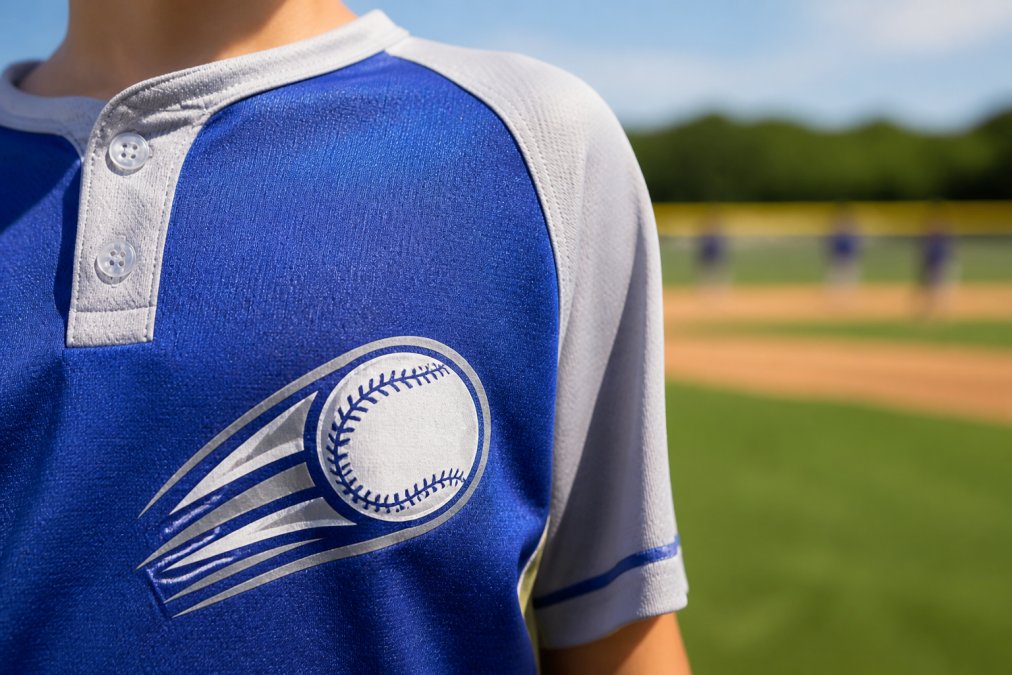
For screen printing, polyester holds plastisol inks cleanly and takes sublimation printing better than any natural fiber. That matters if you want a design that stays sharp after twenty washes. Many parents ask how to keep a print from cracking, and the answer usually starts with the fabric underneath it.
Pros: Affordable, fast drying, excellent print adhesion, wrinkle-resistant. Cons: Can feel slick against skin, holds odor if not washed promptly.
2. Polyester-Spandex Blend: Four-Way Stretch for High-Movement Sports
A polyester-spandex blend adds elastane for stretch that moves in every direction. Four-way stretch means the fabric flexes both horizontally and vertically, which is why volleyball and basketball players gravitate toward it.
The tradeoff is price. Spandex content raises the cost per unit, and higher spandex percentages can pill if washed hot. For teams that need compression fit and freedom of movement, though, nothing else performs the same way.
3. Nylon: Lightweight Durability for Compression and Contact Sports
Nylon is stronger than polyester by tensile strength and lighter per square meter, which makes it a natural fit for compression wear and contact sports. It resists abrasion well, so it survives turf, mats, and repeated collisions.
The catch: nylon alone traps heat. Look for interlock knit constructions or mesh ventilation panels to offset that. Football and wrestling gear often pairs nylon with spandex for the best of both.
Pros: Very durable, lightweight, abrasion resistant. Cons: Less breathable alone, slower drying than polyester.
4. Moisture-Wicking Fabric Properties: What Actually Matters for Athletic Performance
Moisture-wicking fabric properties come down to four measurable factors: fiber chemistry, capillary action, drying time, and fabric weight measured in GSM (grams per square meter). A shirt can carry a "moisture-wicking" hangtag and still fail on three of the four.
Fiber chemistry. Polyester, nylon, and polypropylene are hydrophobic, they repel water at the molecular level, so sweat travels along the fiber surface rather than soaking in. Cotton and bamboo viscose are hydrophilic; they absorb water into the fiber itself, which is why a soaked cotton tee stays heavy and clings.
Capillary action. Wicking is a physical process, not a chemical coating. The fabric's knit structure, usually a birdseye, mesh, or interlock, creates narrow channels between filaments. Water moves through those channels by capillary pressure, spreading from the skin side to the outer face where it can evaporate. A tight, flat knit has fewer channels and wicks poorly even if the fiber is polyester. This is why two 100% polyester jerseys can perform very differently.
Drying time. The standard reference point is AATCC Test Method 199, which measures how long a fabric takes to dry after controlled wetting (aatcc.org). Most performance knits dry in 20-30 minutes under that test; cotton typically takes two to three times longer (peer-reviewed research). If a supplier can't tell you the dry time, ask for the fabric's moisture-management finish spec instead.
GSM and weight. GSM tells you density, and density drives both breathability and print behavior:
- 130-150 GSM: Lightweight, highly breathable, best for hot-weather sports and sublimated jerseys. Can feel flimsy and shows body contours.
- 150-180 GSM: The sweet spot for most team uniforms. Balances airflow with enough opacity for screen printing.
- 180-220 GSM: Heavier knits that hold shape, resist pilling, and print with crisp edges. Better for cold-weather training gear and hoodies.
- 220+ GSM: Too heavy for active play; reserved for warm-ups and outerwear.
Anti-microbial and odor control are separate features. They come from a silver-ion or zinc-based finish applied after knitting, not from the fiber itself. That finish washes out over time, usually 30-50 home launderings, so "odor-resistant" claims should be read as temporary, not permanent.
AATCC Test Method 199 moisture management standard
5. Cotton and Cotton Blends: Comfort and Print Quality for Casual Team Gear
Cotton remains the comfort king for casual team gear and fan apparel. It prints beautifully, feels soft against skin, and takes screen printing and direct-to-garment methods with excellent colorfastness.
What cotton does not do is manage sweat. It absorbs moisture and holds it, which is fine for a post-game hoodie but wrong for a tournament jersey. Blends that mix cotton with polyester, like a 50/50 DryBlend, split the difference: they keep some softness while adding wicking.
6. Merino Wool and Bamboo Viscose: Natural Fibers for Temperature Regulation and Odor Resistance
Merino wool and bamboo viscose are the two natural fibers worth considering for athletic wear, and each solves a problem synthetics handle poorly. But they are not interchangeable, and the right pick depends heavily on the climate your team plays in, a factor most fabric guides skip entirely.
Merino Wool: Cold-Weather and Temperature-Swing Performance
Merino's advantage is its fiber structure. Each merino fiber has a crimped, scaly exterior that traps air in millions of tiny pockets, creating insulation without bulk. The fiber also absorbs up to roughly 30% of its own weight in moisture vapor before it feels damp, which is why merino base layers stay comfortable through a hard workout even when a polyester tee would be soaked.
What to look for:
- Micron count: 17.5-19 microns is the standard for next-to-skin athletic wear. Anything above 21 microns tends to prickle.
- Blend ratio: 100% merino is soft but wears quickly. A common athletic blend is 85-90% merino with 10-15% nylon for abrasion resistance, or a small percentage of spandex for stretch.
- Weight: 150-190 GSM for base layers; 200-260 GSM for mid-layers in cold-weather sports like Nordic skiing, fall soccer, and cross-country.
Where merino wins: Cold-weather sports, temperature-swing conditions (early-morning practices that warm up by noon), multi-day tournaments where laundry access is limited, and any athlete who reacts poorly to synthetic fabrics against the skin.
Where merino loses: Hot-weather sports. Merino insulates, and insulation is the opposite of what a summer track athlete needs. It's also slower to dry than polyester and costs significantly more per unit, often two to three times the price of a comparable polyester jersey.
Bamboo Viscose: Sensory-Friendly Comfort and Recovery Wear
Bamboo viscose is a regenerated cellulose fiber spun from bamboo pulp. It is not the same as "bamboo linen," which is mechanically processed and much rougher. The viscose form is exceptionally smooth, the fiber surface has no scales and very low friction, which is why it's popular for athletes with sensory sensitivities, eczema, or skin that chafes under synthetic seams.
What to look for:
- Blend ratio: 95% bamboo viscose / 5% spandex is common for recovery wear. Blends with 30-40% cotton improve durability without losing softness.
- Weight: 160-200 GSM for tees and lounge pieces; 240+ GSM for recovery hoodies.
- Certification: Look for Oeko-Tex Standard 100 or similar third-party testing, since bamboo viscose processing can involve harsh chemicals if not managed.
Where bamboo viscose wins: Recovery wear, travel gear, warm-weather lounging, and any application where skin feel matters more than moisture management. It's also a strong choice for athletes who find polyester "slick" or "clammy."
Where bamboo viscose loses: High-sweat competition. It absorbs moisture like cotton and dries slowly. It also shrinks noticeably if tumble dried on high, expect 5-8% shrinkage on the first hot wash, and it pills faster than merino under abrasion.
Climate-Specific Quick Reference
| Climate / Sport Context | Best Natural Fiber Pick | Why |
|---|---|---|
| Cold-weather outdoor (Nordic skiing, fall soccer) | Merino wool, 200+ GSM | Traps air, insulates when damp |
| Temperature-swing practices | Merino wool, 150-190 GSM | Regulates across a wide range |
| Hot-weather training | Bamboo viscose blend | Breathable, smooth, low friction |
| Recovery and travel | Bamboo viscose, 160-200 GSM | Softest against sensitive skin |
| Multi-day tournaments, limited laundry | Merino wool | Natural odor resistance |
For team uniforms, synthetics usually win on budget and durability. For base layers, recovery wear, and cold-weather gear, natural fibers are worth the premium, provided you match the fiber to the climate, not just the sport.
7. Custom Apparel Fabric Care Guide: How to Make Your Prints Last
Print longevity depends more on washing habits than on ink quality. A custom apparel fabric care guide that actually works comes down to four rules: wash inside out, use cold or warm water, skip the dryer when you can, and never iron the print.
Here is the routine that keeps designs sharp:
- Turn the garment inside out before washing
- Wash warm at 40°C (105°F) maximum with similar colors
- Use only non-chlorine bleach, or skip bleach entirely
- Tumble dry low, or hang dry for best results
- Do not dry clean
- Do not iron the printed area
That routine matches the care instructions on youth tees like the Born to play baseball Youth T-shirt ($19.99), which uses a soft cotton build with double-needle stitching and a tear-away label. The same washing rules apply whether you order from a small shop or a big-box store.

For families coordinating gear across multiple sports, Merch by Mary Ellen carries baseball, softball, and volleyball collections with personalization options on select items.
Frequently Asked Questions
What is the best fabric for moisture-wicking sports clothes?
Polyester and polyester-spandex blends lead for moisture-wicking fabric properties because they move sweat away from the skin and dry fast. Look for terms like hydrophobic or wicking rate on the spec sheet. Natural fibers like merino wool also regulate temperature but cost more. For most youth team uniforms and custom sports apparel, a polyester or polyester-spandex blend delivers the best balance of performance, print quality, and price.
Are synthetic or natural fabrics better for custom sports apparel?
Synthetic fibers like polyester, nylon, and elastane win for high-sweat sports because they wick moisture, hold sublimation prints, and resist shrinking. Natural fibers like cotton and bamboo viscose feel softer against the skin and work well for casual fan gear or low-intensity activities. Many custom sports apparel pieces use a blend, such as 50% cotton and 50% polyester, to combine comfort with moisture management. The right pick depends on how hard the garment will be worn.
How does fabric choice affect the quality of custom screen printing?
Fabric choice directly affects how well a print adheres and how long it lasts. Polyester and polyester-spandex blends accept sublimation printing, which dyes the fabric rather than sitting on top, so colors stay vivid and resist cracking. Cotton takes screen printing well but can fade faster with heavy washing. For the best fabric for custom screen printing on performance gear, choose a polyester blend with a tight interlock knit and follow the care guide to avoid peeling.
Is cotton suitable for custom sports apparel?
Cotton works for low-intensity sports, warm-up gear, and casual team-spirit shirts, but it absorbs sweat and dries slowly, which can feel heavy during games. Blends like 50/50 cotton-polyester offer a middle ground: the soft feel of cotton with better moisture management. For high-contact sports or tournament days, a polyester or polyester-spandex blend is the more practical choice for custom sports apparel.
What fabric is most durable for high-contact sports jerseys?
Nylon and polyester-spandex blends hold up best for high-contact sports because they resist abrasion, tearing, and stretching. Look for a fabric weight around 180 to 220 GSM with a tight interlock knit or mesh ventilation panels. Reinforced stitching and side-seam construction also extend the life of a jersey. For youth athletes who slide, dive, and tumble, these durable fabrics keep the jersey looking sharp through a full season.
Fabric selection can feel overwhelming when you are ordering for a whole team on a deadline. Merch by Mary Ellen takes the guesswork out with sports-themed apparel built for real wear, including personalization on select items, a range of styles for kids and adults, and collections organized by sport so you can outfit everyone fast. Get started with Merch by Mary Ellen and find gear your team will actually want to wear.