

Table of Contents
- Understanding Tall vs Regular Sizing Differences
- How to Measure for Tall Men's Clothing
- Key Body Measurements for Choosing the Right Size
- Best Fabrics for Tall Men's Activewear
- Common Fit Issues Tall Men Face and How to Solve Them
- Size Chart Comparison and Fit Profile Selection
- Managing Shrinkage and Maintaining Your Tall-Sized Apparel
- Conclusion
- Frequently Asked Questions
Last Updated: September 24, 2026
Understanding Tall vs Regular Sizing Differences
Regular sizes assume an average height of 5'9" to 5'10", while tall sizes extend sleeves, torso, and inseam for frames 6'2" and taller.
Regular sizing on tall men creates visible gaps: wrists show below sleeves, shirts ride up when sitting, and pants hit mid-calf instead of ankles.
Tall sizing adjusts shoulder seams, torso length, and overall silhouette, not just sleeve length, to match vertical proportions.
Here's what actually changes between sizes:
- Sleeve length: Tall sizes add 1.5 to 2 inches
- Torso length: Extended by 2 to 3 inches from armpit to hem
- Inseam: Adds 2 to 4 inches depending on the brand
- Shoulder seam: Positioned slightly lower to maintain proper fit profile
Tailoring cannot lengthen hems and sleeves. Starting with the right size for tall men saves money and frustration.
How to Measure for Tall Men's Clothing
Accurate measurements are essential. Taking 10 minutes to measure yourself properly prevents poor fit and wasted money.
Measuring Inseam and Torso Length
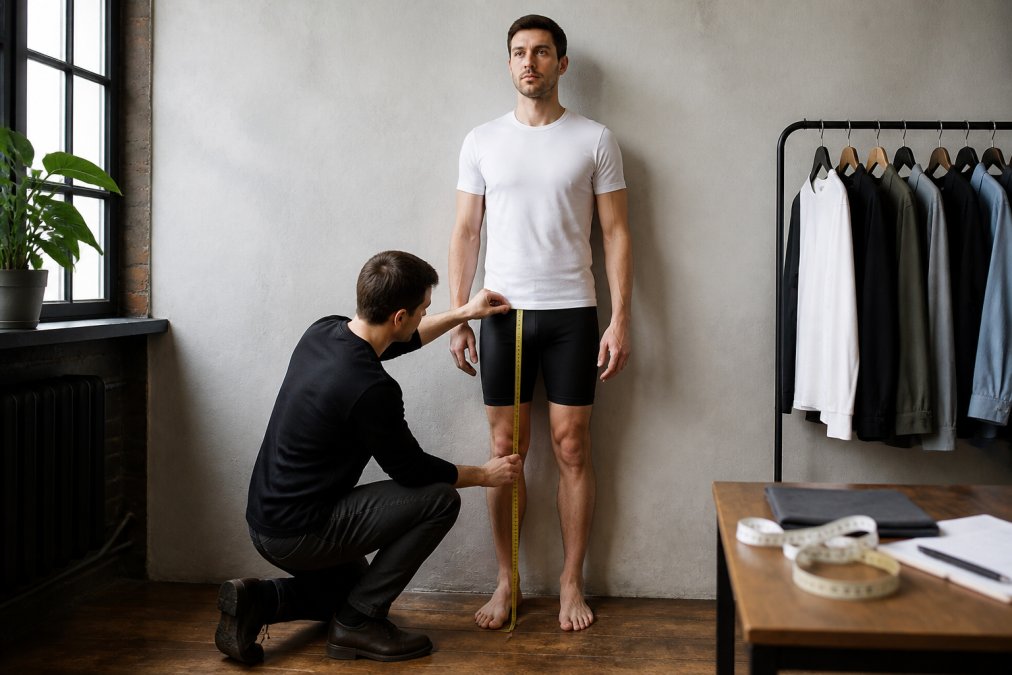
Inseam, the distance from your crotch to your ankle, determines whether pants hit your shoe tops or ankles.
Stand barefoot with feet shoulder-width apart. Have someone measure from your inside ankle bone to your crotch. Most tall men fall between 32 and 36 inches.
Measure barefoot with natural posture, shoes add 1.5 inches of false length, and feet too close together compresses the measurement.
Torso length, from the base of your neck to your waist, determines whether a shirt covers your stomach when you move or sit.
Measure from the C7 vertebra at the back of your neck to your natural waist. For tall men, this often exceeds 18 inches and prevents constant tucking and riding-up.
Many brands extend inseams but fail to extend torso length proportionally. Always compare torso length on size charts, not just sleeve length.
Determining Sleeve Length and Shoulder Width
Proper sleeve length hits at your wrist bone when your arms hang naturally at your sides.
Extend one arm at shoulder height. Have someone measure from your back neck center, across your shoulder, to your wrist bone. Most tall men need 34 to 36 inches.
Cotton sleeves shrink 0.5-1 inch after the first wash; performance blends shrink 0.25 inches. Account for this when choosing your size.
Measure shoulder width from bone to bone across your back. Tall men typically need 16-18 inches. Proper shoulder width prevents sagging and ensures sleeve seams sit at the shoulder edge.
Recording and Using Your Measurements
Keep measurements in your phone. Compare them to the brand's size chart and check the care tag for fabric content and washing instructions.
If a size chart doesn't list torso length or shoulder width, contact the brand before ordering. Tall sizing is not standardized.
Key Body Measurements for Choosing the Right Size
Measure chest circumference at the fullest point and add half an inch for comfort.
Measure waist where pants normally rest without pulling tight. This should match your pants size exactly.
Measure neck where a collar would sit, leaving one finger's width of space. Most tall men wear 16-17 inches.
Keep measurements accessible. Compare them to the brand's size chart, not the label, charts vary between manufacturers.
Best Fabrics for Tall Men's Activewear
For tall men, shrinkage is a fit killer. A shirt that shrinks one inch becomes unwearable when your torso is already at the edge of proper length.
Understanding Shrinkage by Fiber Type
100% cotton shrinks 3-5%, meaning a 34-inch sleeve loses 1-1.7 inches. Avoid pure cotton for tall-sized basics unless you size up.
Cotton-blend fabrics (60% cotton, 40% polyester) shrink 1-2%, a manageable loss, and hold shape better through repeated washing.
Performance fabrics like polyester, nylon, and spandex blends shrink less than 1%, making them the most stable choice for tall frames. A garment labeled 88% polyester, 12% spandex will maintain its length through dozens of washes. For activewear and workout clothing, performance fabrics are non-negotiable if you want consistent fit.
Linen and linen blends shrink 3-4% and are unpredictable. Avoid linen for tall-sized clothing unless you're willing to accept significant length loss or have items professionally laundered.
Fabric Behavior and Tall-Frame Fit
Beyond shrinkage, fabric weight and drape affect how clothing sits on a tall frame.
Lightweight fabrics (under 5 ounces per square yard) cling to tall, lean frames and can emphasize a boxy silhouette if the cut isn't tailored. Heavier blends (6-8 ounces) provide structure and create cleaner lines. When choosing activewear, check the fabric weight on the product description. Heavier fabrics are worth the trade-off in breathability for tall men.
Stretch content with at least 5% elastane or spandex allows movement without baggy fit. Look for this in athletic wear specifically. Non-stretch fabrics on tall frames can feel restrictive across the shoulders and chest because the proportions are already extended.
Fabric finish matters. Fabrics with a brushed or fleece interior (like sweatshirts) tend to shrink more than smooth finishes. If you buy a brushed fleece sweatshirt in tall sizing, expect 1-1.5 inches of length loss. Smooth-finish performance fabrics shrink minimally.
Practical Fabric Selection for Tall Men
When shopping for tall-sized clothing:
-
Check the fiber content first. If it's 100% cotton and the care tag allows machine washing, size up one size to account for shrinkage, or choose a different brand.
-
Prioritize blends for everyday wear. A 60/40 cotton-polyester blend offers comfort, durability, and predictable shrinkage (1-2 inches on a 34-inch sleeve).
-
Use performance fabrics for activewear and frequent-wash items. These maintain fit through dozens of cycles.
-
Wash new items before wearing. This reveals how much they'll actually shrink. If a new shirt shrinks more than 1 inch in length after the first wash, you know the brand's tall sizing runs generous or the fabric is unstable.
-
Wash in cold water and air dry when possible. Hot water and high heat compound shrinkage. Cold water and low heat (or air drying) preserve fit by 50-75% compared to standard machine drying.
Avoid these combinations: 100% cotton + warm water + high heat = 3-5% shrinkage (unacceptable for tall frames). Linen + any heat = unpredictable loss. Single-ply knits + frequent washing = progressive stretching and shape loss.
For tall-sized apparel, fabric choice is not just about comfort or style, it's about whether your clothes will still fit after the first month of ownership.
Common Fit Issues Tall Men Face and How to Solve Them
Most tall men encounter the same fit problems repeatedly. Understanding what causes them helps you avoid them.
The rising shirt problem happens when your torso is longer than the shirt design assumes. Your stomach shows when you sit or reach. The solution is measuring your torso length and buying tall-specific sizing. Regular sizing will never solve this no matter the brand.
Sleeve gap at the wrist occurs when sleeves are too short. Your wrist bone shows below the cuff. This signals you need a taller size or a different brand entirely. Some brands cut sleeves shorter than others even within their tall line.
Pants that hit mid-calf mean your inseam is too short.
Size Chart Comparison and Fit Profile Selection
Every brand's size chart differs. A large-tall at one company might feel like a medium-tall at another. This is why measuring yourself matters more than trusting labels.
When comparing size charts, focus on these columns:
- Sleeve length: Look for brands that offer 34+ inches for tall sizes
- Torso length: Find charts that specify length from shoulder to hem
- Shoulder width: Brands that list this tend to fit tall frames better
- Inseam: Should offer 32+ inches for tall sizing
Managing Shrinkage and Maintaining Your Tall-Sized Apparel
Shrinkage destroys fit, especially on tall-sized clothing where every inch matters. A shirt that shrinks one inch becomes unwearable for a tall frame.
Conclusion
Choosing the right size for tall men comes down to measuring accurately, understanding your body proportions, and buying from brands that respect tall sizing. Stop settling for clothing that doesn't fit your frame. Your vertical proportions deserve gear designed specifically for them.
| Measurement | How to Measure | Typical Tall Man Range |
|---|---|---|
| Inseam | Inside ankle bone to crotch | 32-36 inches |
| Torso Length | Base of neck to waist | 18-21 inches |
| Sleeve Length | Back neck center to wrist bone | 34-36 inches |
| Shoulder Width | Shoulder bone to shoulder bone | 16-18 inches |
| Chest | Around fullest point | 40-46 inches |
| Neck | Around natural collar line | 16-17 inches |
Frequently Asked Questions
What is the difference between 'Tall' and 'Big & Tall' sizing?
Tall sizing focuses on vertical proportions, longer inseams, extended torso length, and longer sleeves, for men who are 6'2" and above. Big & Tall sizing adds width to those vertical adjustments, accommodating larger chest circumference and shoulder width. If you're tall but have a standard athletic build, tall sizing alone is usually sufficient. Big & Tall is designed for men who need both vertical and horizontal adjustments.
How do I measure my inseam for tall-sized pants?
Wear shoes you plan to wear with the pants. Stand barefoot or in socks with your feet shoulder-width apart. Have someone measure from the inside of your ankle bone straight up to your groin area, or measure from the inside seam of pants that fit well. Most tall men need inseams of 32-36 inches. Write down the exact measurement and compare it to the size chart before ordering, this is the most critical measurement for pant fit.
Why do standard sizes often fail tall men?
Standard sizing assumes proportions for men around 5'9" to 5'11". For tall men, regular-sized shirts end at the midsection instead of covering the hips, and sleeves fall short of the wrist. Pants have inseams that are too short, creating an awkward hemline. Tall sizing extends all vertical proportions, garment length, sleeve length, and torso length, to match taller body measurements and create proper fabric drape and silhouette.
What fabrics work best for tall men's activewear and sports gear?
Look for performance fabrics with stretch and moisture-wicking properties. Cotton-polyester blends (70/30 or 80/20) offer durability and comfort, while fabrics with spandex or elastane provide the flexibility tall frames need for movement. Tapered cuts in performance materials help maintain proper proportions on taller, slimmer builds without excess fabric bunching.