

Table of Contents
- What You'll Need to Design Custom Family Shirts
- Best Software for T-Shirt Design
- Step-by-Step: How to Design Custom Family Shirts
- Family Reunion Shirt Design Ideas
- High Quality Custom Team Apparel Online: Fabric and Material Choices
- Cost-Benefit Analysis: DIY Design vs. Professional Printing
- Design Psychology for Group Visibility and Coordination
- File Preparation and Technical Requirements
Last Updated: August 24, 2026
What You'll Need to Design Custom Family Shirts
Designing custom family shirts requires the right tools, software, and understanding of what makes a design work across different body types and fabrics. Gather these essentials: access to a design platform (online or desktop), a clear vision of your concept, and knowledge of file formats your printer accepts. Understanding the difference between vector artwork (infinitely scalable, ideal for screen printing) and raster images (JPEGs, better for digital printing) shapes every decision that follows.
Decide whether you're designing solo or managing group input. Family reunion projects often involve multiple people, requiring clear communication and version control. Solo projects move faster but group designs need structured feedback processes.
Best Software for T-Shirt Design
Canva works best for beginners, combining simplicity with a massive template library. The interface is intuitive, though the free tier has limitations on downloads and customization.
Adobe Creative Suite (Illustrator and Photoshop) remains the industry standard for professional control. Illustrator excels at vector creation, Photoshop handles complex raster designs. The learning curve is steep, but capabilities are unmatched.
Procreate (iPad-only) bridges simplicity and power with professional results at a reasonable one-time purchase price.
Printful and other platforms integrate design tools directly into their platforms, eliminating file-transfer steps. You design, preview on actual apparel mockups, and submit for production without leaving the platform.
Step-by-Step: How to Design Custom Family Shirts
Step 1: Choose Your Design Studio and Online Tools
Select a design platform matching your technical comfort level. Online design studios offer drag-and-drop interfaces where you select templates, modify colors, and add text with immediate visual feedback on shirt mockups.

Create an account and explore the template library. Filter by occasion (family reunion, vacation, sports team) to narrow options quickly.
Step 2: Select Your Shirt Style and Fabric
Your shirt choice affects design placement and visibility. T-shirts offer a large front canvas, hoodies concentrate designs on the chest, and polo shirts have smaller print areas requiring tighter composition.
Fabric choice influences how your design looks after printing and washing. Cotton is durable and holds color well, while blends (cotton-polyester) provide better durability for frequent washing. Performance fabrics wick moisture and resist pilling, ideal for active families.
Heavier weights (6.0+ oz) provide better ink coverage and durability than lighter weights (4.2-5.0 oz), though they feel stiffer initially (astm.org).
Step 3: Create Your Layout and Typography
Place your focal point in the center-chest area, roughly 3-4 inches below the neckline for optimal visibility (aiga.org). Sans-serif fonts (Arial, Helvetica, Futura) read better at a distance than serif fonts. Keep text size above 12 points for body text and 24+ points for headlines.
Avoid overly complex letter spacing that can blur during printing. Leave adequate breathing room between letters.
Step 4: Customize with Names and Slogans
Adding personalized text transforms a generic shirt into something meaningful. Keep text concise, "Smith Family Reunion 2026" works better than lengthy descriptions. Position names strategically: back-neck placement creates unity when worn together, chest placement ensures visibility in photos.
Step 5: Upload Your Own Artwork or Use Templates
If you have existing artwork, upload it to your design studio. Most platforms accept PNG, SVG, and PDF files at 300 DPI minimum for crisp printing. Check the color mode: RGB is standard for display, but print-ready files should be CMYK. Many design studios handle this conversion automatically.
Step 6: Choose Your Printing Method
Screen printing uses separate screens for each color, economical for large orders (50+ units) with vibrant, durable results. Setup fees make small orders expensive, and colors are typically limited to 3-4 maximum.
Digital printing excels with complex, multi-color designs and photo-realistic images. There's no setup fee, making small orders affordable. It works well for one-off designs or orders under 25 units, though durability is slightly less than screen printing.
Heat transfer (iron-on) suits DIY enthusiasts with small quantities but requires equipment investment and careful application.
Family Reunion Shirt Design Ideas
Family reunion shirts create visual unity and make group photos memorable. Consider designs featuring your family name prominently with the reunion year and location. Add a simple graphic element (lighthouse, beach umbrella, family tree illustration) to make it visually interesting.
Another approach uses a family crest or coat of arms if available, adding heritage and formality. For casual gatherings, humorous designs work well with inside jokes or playful graphics. Sports-themed families might incorporate favorite team colors or mascots alongside family branding.
Consider your family's demographic. Multi-generational designs should prioritize legibility and avoid trends that date quickly.
High Quality Custom Team Apparel Online: Fabric and Material Choices
100% cotton remains the gold standard for comfort and breathability, though dark colors fade slightly faster than blends. Cotton-polyester blends (50/50 or 65/35) offer a middle ground, retaining color better while maintaining comfort and reducing shrinkage.
Performance fabrics (polyester-spandex blends) suit active families, wicking moisture and resisting odor. Sustainable options like organic cotton and recycled polyester cost 10-15% more but align with environmental values (textileexchange.org).
Heavier fabrics (6.0+ oz) maintain appearance longer than lighter weights (4.2-5.0 oz), which pill more easily. For reunion shirts worn infrequently, lighter weight is fine. For regular wear, invest in heavier construction.
Cost-Benefit Analysis: DIY Design vs. Professional Printing
DIY design using online platforms costs almost nothing upfront but requires 4-8 hours of your time. Professional design services cost $100-$500 but deliver polished results in 1-2 hours.
Printing costs vary by method and quantity. Screen printing a 50-shirt order costs $8-$12 per shirt; digital printing costs $12-$18 per shirt. For 10 shirts, digital printing becomes cheaper ($12-$15 per shirt) because there's no setup fee.
Quality perception matters for special occasions. Professionally designed shirts look noticeably better in reunion photos. The break-even point is around 25 shirts: below that, DIY design plus digital printing costs less; above 25 shirts, professional design plus screen printing becomes economical.
Design Psychology for Group Visibility and Coordination
Matching family shirts signal belonging, unity, and shared identity. Bright, saturated colors stand out in photos; pastels create softer impressions; neutral colors feel timeless but blend into backgrounds.
For family reunions, choose colors complementing most skin tones and your anticipated environment. Beach reunions benefit from lighter, brighter colors; mountain reunions work with deeper, earthier tones.
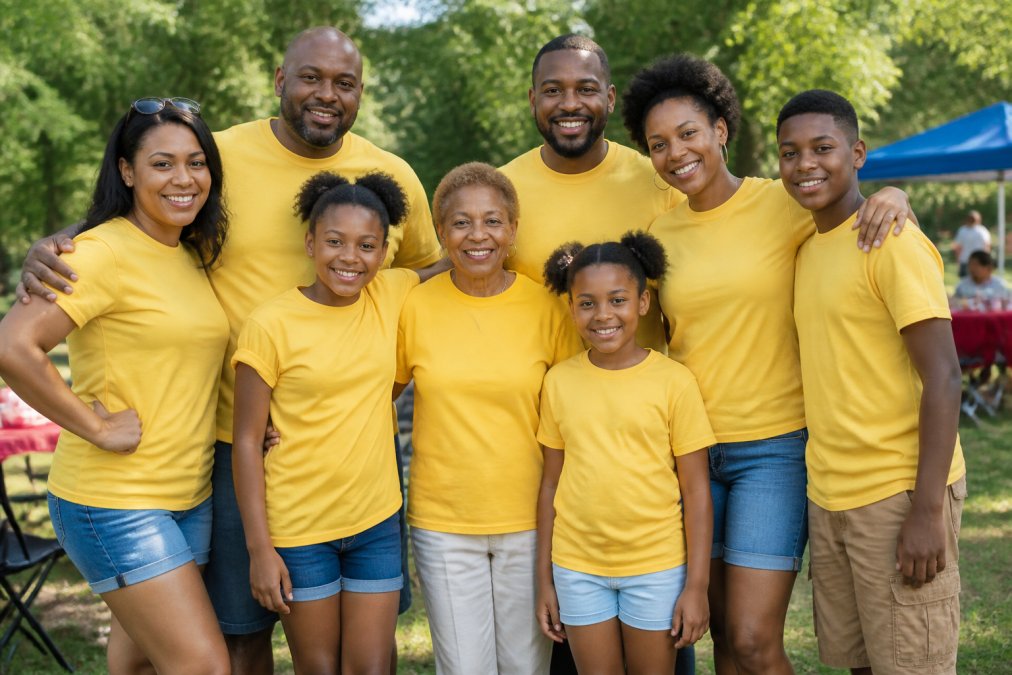
Consistency in design across all shirts strengthens group identity. Centered designs feel balanced and formal; asymmetrical placements feel modern and casual. Ensure the design is proportional across all shirt sizes.
High contrast (dark design on light shirt) reads clearly in photos and public settings. For family gatherings where photos matter, prioritize contrast.
File Preparation and Technical Requirements
Resolution is non-negotiable. Screen printing requires vector artwork or raster images at 300 DPI minimum. Digital printing needs 150 DPI minimum, though 300 DPI is safer.
Convert your design to CMYK before submitting; RGB prints unpredictably. Screen printers prefer vector files (EPS, AI, PDF); digital printers accept vector or high-resolution raster (TIFF, PNG). Never submit JPEGs for screen printing.
Provide a quarter-inch bleed for full-coverage designs and keep important elements at least a quarter-inch from edges to prevent accidental cropping. Test your design at actual size on regular paper before committing to production.
Designing custom family shirts transforms a simple apparel order into a meaningful keepsake. Starting with the right design studio, selecting quality fabric, and understanding your printing options sets you up for success. Merch by Mary Ellen simplifies this workflow with integrated design tools, quality fabric options, and print-on-demand capabilities that eliminate guesswork. Whether coordinating a family reunion, celebrating a milestone, or creating matching vacation wear, thoughtful design and quality execution produce shirts your family will wear proudly for years.
Frequently Asked Questions
What is the best program to create shirt designs?
The best software for t-shirt design depends on your skill level. Beginner-friendly options include Canva and design studios built into print-on-demand platforms, which offer templates and drag-and-drop interfaces. For more advanced work, Adobe Illustrator or Photoshop provide professional-grade tools. Many print shops also offer their own design studios where you can upload artwork or customize templates without needing separate software. Choose based on whether you want simplicity or advanced customization options.
How do I ensure my custom family shirts won't fade or peel after washing?
Print durability depends on the printing method and fabric quality. Screen printing typically offers excellent washability and longevity compared to iron-on transfers, which can peel after repeated washing. Choose high-quality fabrics like 100% cotton or cotton-blend garments, as they hold ink better. Ask your printer about their ink type and curing process. Proper care, washing in cold water, turning shirts inside out, and air-drying, significantly extends print life. Reputable custom apparel providers test their printing methods to ensure durability through multiple wash cycles.
What are good family reunion shirt design ideas?
Popular family reunion shirt design ideas include the family name with the reunion year and date, a family tree graphic, matching color palettes with individual names, or a humorous family motto. You can also incorporate family photos, heritage symbols, or inside jokes that resonate with your group. Consider adding elements like family reunion location, a custom logo, or coordinating icons for different family branches. Keep the design readable and not too cluttered, simpler designs with bold typography often have the most impact when worn as a group.
Can I order custom family shirts without a minimum quantity requirement?
Many print-on-demand services and custom apparel providers now offer no-minimum orders, allowing you to order just a few shirts for small families or test designs before placing larger orders. However, bulk orders typically offer better per-shirt pricing. When choosing a provider, confirm their minimum order requirements upfront, as some traditional screen printers may require minimums while modern digital printing services often do not. This flexibility makes it easier to get high quality custom team apparel online without committing to large quantities.
This article was written using GrandRanker