

Table of Contents
- Step 1: Build Your Design Brief and Team Decision Process
- Step 2: Choose a Sport, Jersey Style, and Design Template
- Step 3: Use Jersey Design Software to Build Your Concept
- Step 4: Custom Jersey Design Ideas for Logos, Names, and Numbers
- Step 5: Nail Custom Jersey Logo and Number Placement
- Step 6: Prepare Artwork and Choose a Printing Method
- Step 7: Sizing, Fit, Budget, and Your Custom Team Jersey Order Checklist
- Conclusion: From Design Proof to Game Day
- Frequently Asked Questions
Last Updated: October 4, 2026
Step 1: Build Your Design Brief and Team Decision Process
Designing custom sports team jerseys starts with a one-page brief, not a design tool. According to the U.S. Consumer Product Safety Commission, children's apparel must meet specific labeling rules, so knowing your roster's sizes and ages early saves rework later.
A brief answers five questions:
- What sport and level? (youth rec, travel, adult league)
- How many players, and what sizes?
- What's the budget per jersey?
Write it down. Share it. Then start designing.
Who Decides What on a Team Jersey
Split decisions by category to avoid committee gridlock:
- Coach decides: colors, number style, league compliance
- Team parent or manager decides: budget, order deadline, vendor
- Players decide: optional nickname or sleeve detail
One person should hold final approval; committees end up with jerseys nobody loves.
Step 2: Choose a Sport, Jersey Style, and Design Template
Pick the sport first, because it dictates everything else: basketball jerseys are sleeveless with a wide shoulder cut, baseball jerseys have buttons and a fuller fit, and soccer jerseys are lighter and closer-cut.
From there, choose a style:
- Classic: solid colors, simple block lettering
- Modern: gradients, geometric shapes, bold numbers
- Vintage: throwback fonts, muted tones, retro stripes
Most teams do best starting from a design template, which handles proportions and print-safe margins while you customize colors, text, and artwork.
Pick Team Colors and a Color Palette That Reads on the Field
Two colors plus a neutral is the safest palette: one dominant, one accent, one trim. The test: squint from across the room. If the number disappears into the background, contrast is too low.
- Dark jersey? Use a light number with a dark outline
- Light jersey? Use a dark number with a light outline
- Avoid two mid-tone colors next to each other
A palette that looks sharp on screen can turn muddy in fabric.
Step 3: Use Jersey Design Software to Build Your Concept
Jersey design software lets you build, preview, and revise a concept without ordering a sample. Most tools work the same way: pick a template, add colors, upload artwork, place text, then preview. Choosing the right tool first prevents costly rework.
Match the Tool to the Job
You have three paths, and each has a clear best-fit scenario:
Online designer: Browser-based, drag-and-drop, fastest option. Best for simple designs, tight deadlines, and teams without an artist. Trade-off: limited control over fine typography and custom shapes, and templates can look generic.
3D designer: Shows the jersey on a rotating model. Best when fit and drape matter, like fitted softball or soccer jerseys, or to see how a pattern wraps around side panels.
Design from scratch: Full creative control using vector software. Best when you have a real logo and want something no other team owns.
For most youth and rec teams, the online designer wins: it's fast, free to preview, and prevents hand-built sizing mistakes.
A Practical Design-Tool Workflow
Whichever tool you pick, run the same sequence so revisions stay cheap:
- Lock the brief first. Colors, sport, and budget from Step 1 should already be decided. Don't open a tool to figure out what you want.
- Start from a template, then break it. Templates handle print-safe margins and proportions. Once the layout works, swap in your own type and artwork.
- Place the hero element before the details. Logo or wordmark first, then numbers, then accents. If the hero doesn't read at a glance, nothing else matters.
- Preview at game distance. Zoom out until the jersey is thumbnail-sized. If the number disappears, fix contrast now, not after the proof.
- Save and export a proof. Download the preview as a PDF or image and circulate it. Screenshots of a live editor can hide color and alignment problems.
When a Design Tool Is the Wrong Choice
Skip the online designer and hire a professional when any of these is true:
- Your logo only exists as a low-resolution JPG or a photo of a printed shirt
- You need a fully custom cut, not a recolor of a stock template
- The design has fine linework, gradients, or small text that must survive printing
What to Check Before You Leave the Tool
Before you close the designer, confirm you can answer yes to all of these:
- The design uses only colors from your locked palette
- Every number and name is spelled correctly and matches the roster
- The logo has a transparent background, not a white box
A saved project becomes next season's starting point, and a shared proof becomes your paper trail if a dispute arises.
Step 4: Custom Jersey Design Ideas for Logos, Names, and Numbers
Great custom jersey design ideas come from the team's own identity, not a clip-art library. Try these directions:
- Mascot-forward: big mascot mark on the chest, small wordmark on the sleeve
- Wordmark-led: team name across the chest in a bold font, logo on the sleeve
- Number-led: oversized number on the front, name and number on the back
Keep the front readable from 30 feet. Keep the back clean so names and numbers stay legible.
A common mistake is cramming too many elements onto one jersey. Pick one hero element and let everything else support it.
Step 5: Nail Custom Jersey Logo and Number Placement
Custom jersey logo and number placement follows a simple rule: front chest for identity, back for the player, sleeves for accents.
Custom One Team. One Heart. One Goal Basketball Kids T-shirt →
Standard placement:
- Front chest: team logo or wordmark, centered
- Front upper corner: small number or sponsor mark
- Back: player last name above a large number
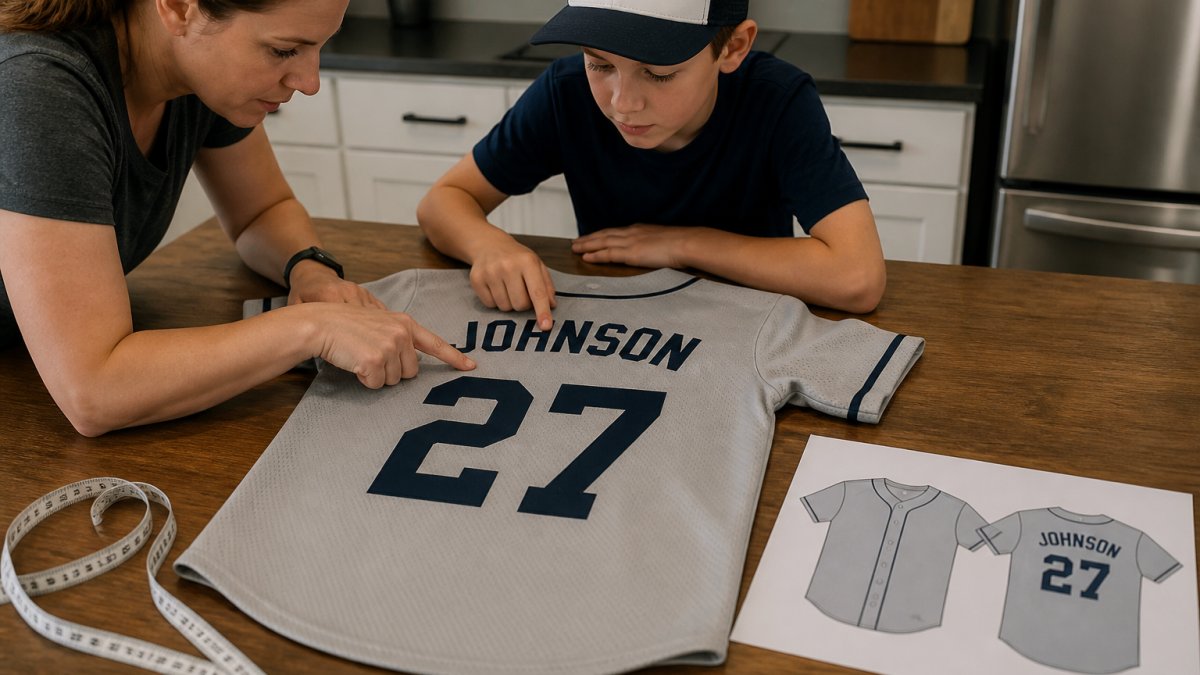
Measure before you commit. A logo that sits too high crowds the collar. A number that sits too low disappears under a belt or waistband.
League Rules and Number Visibility
Leagues set their own uniform rules, and they vary by sport and age group. Before you finalize placement, check your league's rulebook for:
- Allowed number ranges (some leagues ban 0, 00, or numbers over 99)
- Minimum number height on the back
- Contrast requirements between number and jersey color
The National Federation of State High School Associations publishes uniform rules that many youth and school leagues reference. When in doubt, ask your league director before you approve the proof. A non-compliant jersey means a reorder.
Step 6: Prepare Artwork and Choose a Printing Method
Artwork preparation decides how sharp your jersey looks, and the printing method decides how long it stays that way. Treat them as one decision.
Artwork and File-Preparation Specifications
Send vector files (AI, EPS, SVG, or PDF) when you can, they scale to any size without blurring. If you only have a JPG or PNG, send the largest version you have, but a small raster file will look soft no matter how good the printer is.
Check these before you upload:
- Resolution: At least 300 DPI at final print size for raster files. A 72 DPI web logo will not survive a 10-inch chest print.
- Background: Removed or transparent. A white box behind your logo will print as a white box.
- Color mode: Convert to CMYK or the printer's specified profile. RGB colors can shift when they hit fabric, especially bright greens and oranges.
If you don't have the vector source, ask the original designer; a professional redraw is usually cheaper than a reprint.
Printing-Method Trade-Offs
Sublimation: Dye bonds into the fabric, so it won't crack or peel and feels like part of the garment.
Screen printing: Ink pushed through a mesh screen, one screen per color. Extremely durable and cost-effective at high quantities.
Heat transfer (vinyl or digital transfer): Design pressed on with heat and pressure.
Embroidery: Thread stitched directly into the garment. Premium look and feel, excellent durability.
| Method | Best For | Durability | Fabric | Design Complexity |
|---|---|---|---|---|
| Sublimation | Full-color all-over designs | Highest | Light polyester | High (gradients, photos) |
| Screen printing | Bold, few-color designs at volume | High | Cotton and blends | Low to medium |
| Heat transfer | Small runs, names and numbers | Medium | Most fabrics | Medium |
| Embroidery | Logos on polos and outerwear | Highest | Most stable fabrics | Low |
How to Choose
Work through these questions in order:
- What fabric is the jersey? Polyester opens up sublimation. Cotton and blends point to screen printing or transfer.
- How many colors and how complex? Few colors and high quantity favor screen printing. Gradients and photos favor sublimation.
- How many jerseys? Small runs favor transfer or digital. Large runs favor screen printing or sublimation.
- How will it be washed? Frequent hot washes and dryers shorten the life of transfers. Sublimation and embroidery hold up best.
- What's the budget? Setup fees, screen charges, and minimums vary by method. Ask for a full quote that separates garment cost from decoration cost.
Always follow the care label: wash inside out, use cold or warm water, and skip the iron.
Proof Approval Before Production
The proof is your last chance to catch errors. Review it for:
- Correct names and numbers for every player
- Correct colors against your locked palette
- Correct logo placement and size
Approve in writing. Once production starts, changes are expensive or impossible.
Step 7: Sizing, Fit, Budget, and Your Custom Team Jersey Order Checklist
Get sizing right the first time. Youth sizes run small compared to adult sizes, and fit varies by brand. Collect sizes from every family in writing, then compare against the vendor's size chart, not a guess.
Budget depends on quantity, fabric, and print method. Ask your vendor for a full quote including setup fees, shipping, and rush charges, and confirm minimum order quantities before you promise jerseys to families.
Use this custom team jersey order checklist:

- Design brief approved by coach and team
- Colors and logo finalized
- League rules checked for number and logo compliance
Conclusion: From Design Proof to Game Day
The gap between a jersey you love and one you regret comes down to process: a clear brief, a compliant design, and an approved proof. Teams that follow these seven steps order once and play in gear that looks sharp all season.
Merch by Mary Ellen makes the final step easy. Our custom team apparel includes personalized front and back options, so you can add your team name, season year, player last name, and jersey number. Shop our Baseball Collection, Basketball Collection, or Softball Collection to find gear built for game day.

Frequently Asked Questions
How much does custom jersey design cost?
Cost depends on the garment and how much personalization you add. At Merch by Mary Ellen, a Custom One Team. One Heart. One Goal. Basketball Kids T-shirt runs $21.99, the adult basketball tee is $36.99, and the customized baseball kids tee is $23.99. Each price covers the front team name and season year, with back name and number personalization available. Budget for one extra shirt per size band so late additions still match the roster.
What file format should a jersey logo be in?
Send vector artwork (AI, EPS, or SVG) when you have it, because vectors scale to any print size without blurring. If you only have a PNG or JPG, use the highest resolution you can find, ideally 300 DPI at the final print size. Avoid screenshots and social media downloads, which lose detail. Ask for a design proof before production so you can catch a pixelated logo before it lands on 15 jerseys.
How do I make sure names and numbers are readable on a jersey?
Contrast does the work. Put a dark number on a light jersey or add a contrasting outline behind it. Keep a clear gap between the number and the name above it, and avoid thin, decorative fonts for digits. Check your league's rules on number size and placement, since many youth leagues require numbers on the back at minimum. Preview the full back layout in the online designer before you approve the proof.
Do custom sports team jerseys fade or peel after washing?
Print durability depends on the method and the care routine. Skip bleach and fabric softener, and never iron directly over a printed logo. Follow the garment's care tag and most custom jerseys hold up through a full season.