

Table of Contents
- Why Getting Sports Uniform Sizes Right Matters for Your Team
- Your Team Uniform Sizing Chart: Reading Measurements That Actually Fit
- How to Measure Players for Uniforms Without the Guesswork
- Youth vs Adult Jersey Sizing: What Coaches and Parents Need to Know
- How to Organize Team Uniform Fittings That Run Smoothly
- The Growth Buffer Calculation: Sizing for Players Who Keep Growing
- Bulk Ordering, Custom Apparel, and Keeping Your Roster Straight
- Conclusion: Lock In Your Sizes Before the Season Starts
- Frequently Asked Questions
Last Updated: October 2, 2026
Why Getting Sports Uniform Sizes Right Matters for Your Team
A uniform that fits poorly affects how players move, how the team looks on game day, and how much money your program wastes on replacements.
Sizing is where most team orders go wrong. A coach collects numbers, guesses at a few, and hopes the sizes work out.
Getting it right starts with one idea: measure people, not assumptions.
Here is what we will cover:
- The three body measurements that decide every fit
- How to run a fitting session that does not eat your whole practice
- Why youth and adult sizing charts do not line up
- How to leave room for players who are still growing
The payoff: fewer returns, fewer exchanges, and a roster that looks sharp from the first whistle.
Your Team Uniform Sizing Chart: Reading Measurements That Actually Fit
A team uniform sizing chart maps body measurements to garment sizes for a specific brand or style. It differs from a retail size chart because you are fitting a whole roster to one cut, not one person to many options.
One brand's adult medium is another brand's small, and a size run can sit an inch or two off between suppliers. This is size variance, the single biggest reason team orders go sideways.
Chest, Waist, and Inseam: The Three Numbers That Decide the Fit
Three measurements do most of the work:
- Chest circumference at the fullest point, tape level under the arms
- Waist measurement at the natural waistline, not where pants sit
- Inseam from the crotch seam to the desired hem
Chest size drives jersey fit; waist and inseam decide shorts and pants. Get these three right and most fit problems disappear.
| Measurement | Where to Measure | Common Mistake |
|---|---|---|
| Chest | Fullest point, arms down | Tape too high, near armpits |
| Waist | Natural waistline | Measuring over bulky clothing |
| Inseam | Crotch seam to hem | Using pant size as a shortcut |
Understanding Size Runs and Size Tolerance Across Brands
A size run is the full set of sizes a supplier offers, from youth small to adult XXL. Size tolerance is how much a finished garment can differ from the listed spec and still pass inspection.
A jersey listed as a 40-inch chest might arrive at 39 or 41, and across a roster those gaps add up.
How to Normalize Measurements Across Brands
"Check the chart" breaks down the moment you compare two suppliers, because the same body measurement lands in different size buckets depending on the brand. The fix: stop thinking in sizes and start thinking in inches.
Here is the mechanism:
- Build a body-measurement roster first. Record each player's chest, waist, and inseam in inches. Do not write down a size yet.
- Pull the spec sheet for each candidate style. Most suppliers publish a finished-garment measurement table, not just a body-measurement table. The finished-garment numbers are what actually arrive in the box.
- Add the garment's ease. Ease is the difference between your body measurement and the finished garment measurement. A jersey cut for movement might carry 4 to 6 inches of ease in the chest; a fitted warmup top might carry 2.
- Match each player to the size whose finished chest measurement equals body chest plus the ease you want.
- Repeat per style. A player who is an adult medium in one jersey can be an adult large in another. That is normal, not a mistake.
A normalization sheet keeps this straight: one column for raw measurements, one per style with the finished-garment spec, and a final column for the matching size.
Youth and Adult Charts Do Not Share a Scale
Youth and adult charts are built on different blocks. A youth XL is not an adult small, even when chest numbers look close: youth cuts run shorter in the torso and narrower in the shoulder, and the gap between the largest youth and smallest adult size can be two full sizes.
When a player sits in that gap, size up to adult rather than squeezing into youth. A slightly long adult small wears better than a youth XL that rides up every time the player raises their arms.
How to Measure Players for Uniforms Without the Guesswork
Measuring players for uniforms takes about two minutes per person with a system: measure everyone the same way, with the same tape, in the same order.
Follow these steps:
- Print the supplier's size chart before the session
- Assign one person to measure and one to record
- Have players wear a fitted t-shirt, not a hoodie
- Measure chest first, then waist, then inseam
- Write down raw numbers, not guessed sizes
- Match numbers to the chart after all players are measured
A common mistake is letting players self-report. Most people guess their size wrong, and kids guess worse. Measure in person whenever you can.
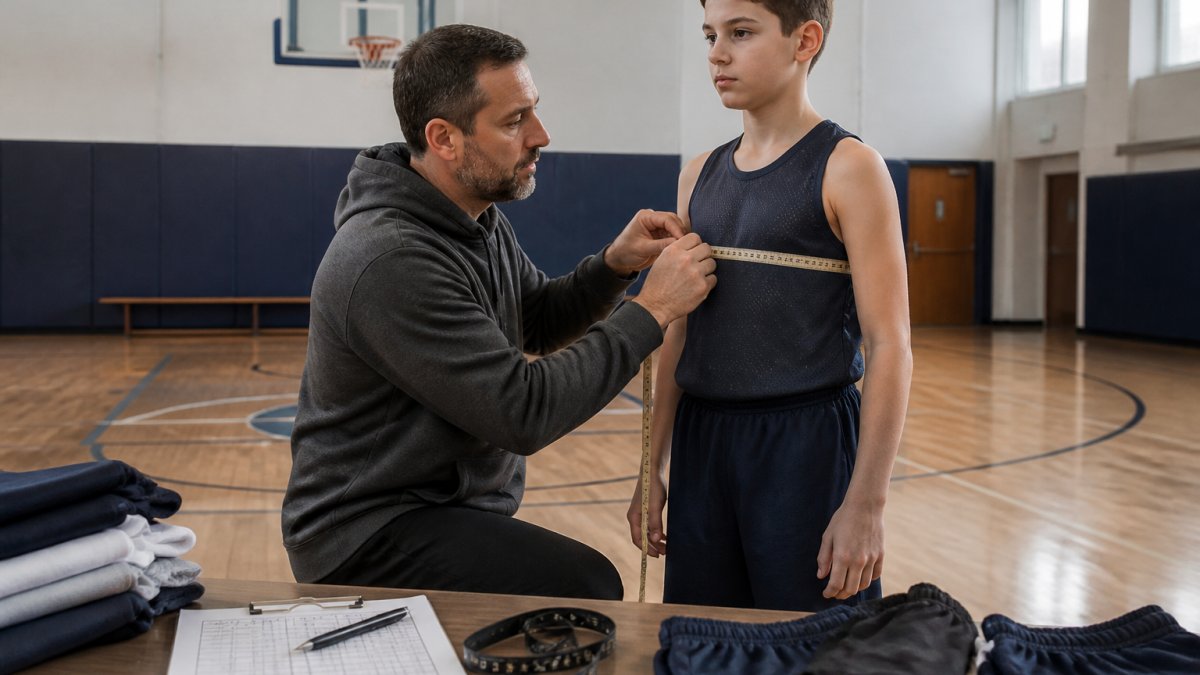
Measuring for Layering and Compression Gear
Compression gear changes the math: a base layer adds bulk under a jersey, so you need more room in the chest and shoulders.
For players wearing compression tops, add a small buffer to the chest measurement before matching to the chart. The same goes for padded shirts or hoodies under a warmup jacket. Most guides skip this step, which is why so many layered uniforms feel tight.
Youth vs Adult Jersey Sizing: What Coaches and Parents Need to Know
Youth and adult jersey sizing do not share a scale. A youth XL is not an adult small, even when the numbers look close on paper. Youth sizes are cut shorter in the torso and narrower in the shoulders; adult sizes add length and width, and the jump between them can be two full sizes, a gap that trips up coaches ordering for mixed-age rosters.
A few rules that help:
- Never assume a player has "aged out" of youth sizing without measuring
- Check the chart for both youth and adult before deciding
- For teens on the edge, size up rather than down
- Keep a few extra youth and adult sizes on hand for late additions
Parents often ask whether to buy the size their child will grow into. For a one-season uniform, buy what fits now, with a small buffer.
How to Organize Team Uniform Fittings That Run Smoothly
A good fitting session runs in 30 to 45 minutes for a full roster. The setup matters more than the measuring itself.
Try this format:
- Set up two stations so players move through faster
- Post the size chart where everyone can see it
- Hand out a sign-up sheet with name, number, and position
- Measure in small groups of five or six
- Double-check any measurement that looks off
Digital Measurement Tools and Fitting Session Logistics
Digital measurement tools can speed things up. Some apps estimate body measurements from a phone camera, and a few suppliers offer virtual fit assistance.
Treat these as a starting point, not a final answer. Camera-based estimates can be off by a size or more, especially for kids who will not stand still. Use them to pre-fill a sheet, then confirm with a tape measure at the fitting session.
The Growth Buffer Calculation: Sizing for Players Who Keep Growing
The growth buffer is a simple rule for sizing players who will not stop growing mid-season: add a set amount to chest and torso length based on age and growth rate.
Here is a workable version:
- Players under 12: add about one size of room in the torso
- Players 12 to 15: add half a size, or a bit of length
- Players 16 and up: size to fit now, with no buffer
The buffer is not about buying baggy gear. It is about avoiding a mid-season replacement order when a growth spurt hits. A jersey with a little room still looks sharp.
Bulk Ordering, Custom Apparel, and Keeping Your Roster Straight
Bulk ordering rewards planning. Before you order, lock down three things: the final roster, the size run, and the deadline.
How to Calculate Order Quantities Without Overbuying
The instinct is to order one uniform per player and call it done. That leaves you short the first time a player joins late, a jersey gets lost, or a size comes back wrong. Most experienced team managers build in a small overage.
A workable formula:
- Base quantity: one per rostered player, per uniform piece
- Overage: add roughly 5 to 10 percent of the roster count in the most common sizes
- Spares: keep at least one extra in the two or three sizes that cover the middle of your roster
For a 20-player roster, that means ordering 21 or 22 of the core sizes rather than exactly 20.
Custom Apparel Timelines and Personalization
For custom apparel, add time for personalization. Names and numbers take longer than blank stock, so build that into your schedule: blank stock ships in days while decorated stock takes weeks, and the gap widens during peak season when every program in the region orders at once.
If a tournament is close, confirm turnaround before you commit. Ask three questions:
- What is the current production lead time for decorated items?
- Does that lead time include shipping, or is shipping added on top?
- What happens if a size is backordered after the order is placed?
Get those answers in writing. A verbal "should be fine" is not a delivery date.
Handling Mid-Season Roster Changes
Rosters move. Players quit, get injured, or join after the season starts. Plan for it before the first order ships.
- Keep the master size sheet live. Update it the moment a player is added or removed.
- Note the exact style and size ordered for each player. If you need to reorder a single jersey six weeks later, you need the style code, not just "the blue one."
- Ask about reorder minimums up front. Some suppliers will run a single piece; others require a minimum quantity per reorder. Knowing this before the season starts changes how many spares you buy.
- Hold spares in the sizes most likely to be needed. For youth teams, that usually means the middle sizes, since kids grow into and out of them fastest.
Merch by Mary Ellen offers personalized options on select items, plus sports-themed apparel across baseball, basketball, football, soccer, and volleyball collections. For families and fans who want coordinated gear, the Shop for Kids and Shop for Women collections cover a full range of sizes and styles.
The Master Tracking Sheet
A simple tracking method keeps the roster straight:
- One master sheet with player name, number, and final size
- A second column for the size ordered
- A third column for delivery status
- A note field for exchanges or late adds
Keep it in one place that more than one person can access. When the assistant coach, the team parent, and the treasurer all need the same answer, a single shared sheet beats three text threads.
Conclusion: Lock In Your Sizes Before the Season Starts
Sizing a full roster is not hard once you have a system: measure every player the same way, read the current chart for the exact style, and leave a little room for players who are still growing.
Merch by Mary Ellen can help you get there. Our personalized options on select items, wide range of sports-themed apparel, and collections built for the whole family make it easy to outfit your team and your fans. Get started with Merch by Mary Ellen and walk into game day with gear that fits right the first time.
Frequently Asked Questions
How do I determine uniform size for my whole team?
Start with a team uniform sizing chart and measure every player's chest, waist, and inseam rather than guessing from street clothes. Collect measurements in one organized fitting session, then compare each number against the manufacturer's chart. Add a small growth buffer for youth players, and confirm whether the jersey runs as an athletic cut or relaxed fit. Merch by Mary Ellen's baseball, softball, and basketball collections list garment dimensions so you can cross-check before submitting a bulk order.
Should you size up or down for jerseys?
Size up if players will wear compression gear or a hoodie underneath, or if they prefer an oversized look. Size down only when the jersey is a loose relaxed fit and the player wants a tighter athletic cut. For youth athletes still growing, sizing up by one is usually safer than sizing down. Always check the specific size chart, because a size 40 jersey in one brand may fit like a medium while another brand's 40 runs closer to a large.
What is a size 40 jersey equal to in standard clothing?
In most jersey size runs, a 40 corresponds roughly to a men's medium or a women's large, though this varies by brand and cut. A 44 is closer to a men's large, a 48 to an XL, and a 52 to an XXL. Because standardized sizing does not exist across manufacturers, treat these as starting points only. Measure the player's chest circumference and compare it directly to the garment dimensions on the size chart before ordering custom apparel.
How do you measure a player for a custom uniform?
Use a soft measuring tape and record three numbers: chest circumference at the fullest point, natural waist, and inseam from crotch to ankle. Have players wear fitted clothing, keep the tape snug but not tight, and measure twice to confirm. For layered uniforms, add 1-2 inches to the chest measurement. Log every measurement in a roster spreadsheet alongside the player's name and preferred fit, then match each entry to the team uniform sizing chart before bulk ordering.