

Table of Contents
- Understanding Youth Sports Schedule Stress
- Signs of Mental Exhaustion in Student Athletes
- Using Youth Sports Scheduling Apps to Organize Your Calendar
- How to Talk to Coaches About Schedule Overload
- Setting Healthy Boundaries and Rest Days
- Balancing Sports, School, and Family Life
- Practical Stress-Management Techniques for Athletes
- Conclusion
Last Updated: August 12, 2026
Understanding Youth Sports Schedule Stress
Youth sports schedule stress is the physical and emotional strain that accumulates when young athletes juggle multiple competitions, training sessions, academic responsibilities, and family commitments simultaneously. This isn't just about feeling busy, it's a genuine physiological response that affects sleep, concentration, mood, and long-term athletic development.
The pressure intensifies when parents, coaches, and athletes become fixated on outcomes rather than improvement. Logistical pressures compound the athletic stress: constant driving between practices, financial strain, coordinating siblings' schedules, and tracking deadlines all contribute to burnout. The good news is that managing youth sports schedule stress is learnable. It requires honest conversations, boundary-setting, and practical tools that help families stay organized without sacrificing the joy that drew their child to sports.
Signs of Mental Exhaustion in Student Athletes
Mental exhaustion in young athletes often appears before physical burnout, yet parents and coaches frequently miss the warning signs. Common indicators include persistent irritability after practice, sudden dread about attending training, sleep disturbances, and noticeable drops in academic performance.
Physical signs accompany the mental ones: recurring minor injuries, persistent muscle soreness, frequent illness, or headaches can all indicate chronic nervous system activation. Watch for withdrawal from teammates and friends, isolation, or perfectionist thoughts about performance.
The key distinction is duration and intensity. Occasional frustration after a tough loss is normal. Persistent anxiety about performance, dread about attending practice, or a fundamental loss of enjoyment suggests the stress load has become unsustainable.
Using Youth Sports Scheduling Apps to Organize Your Calendar
Youth sports scheduling apps reduce the mental load by centralizing information that would otherwise exist across text messages, emails, and scattered calendars. When selecting an app, prioritize multi-athlete support, notification customization, location and travel time calculations, coach communication integration, and shared access for all caregivers.
These apps help families identify patterns that contribute to youth sports schedule stress. When you can see all commitments visually, you notice when a child has practice five days a week plus weekend tournaments. That visibility is the first step toward making intentional decisions about which commitments serve the athlete's development.
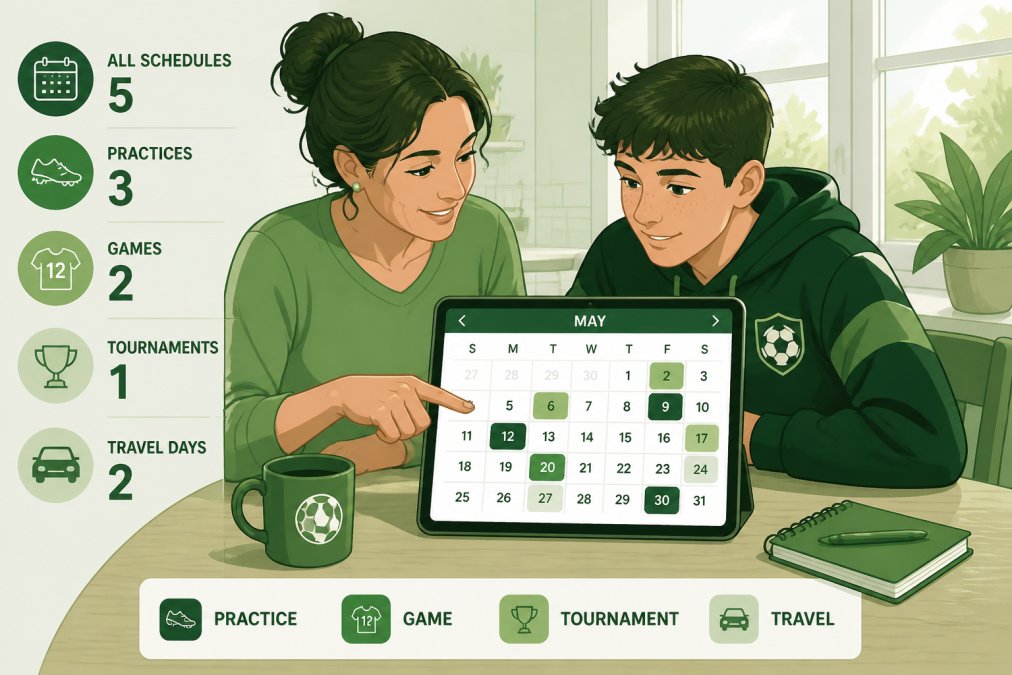
Centralizing information, moving from scattered texts to one organized system, reduces anxiety immediately by eliminating constant mental checking.
How to Talk to Coaches About Schedule Overload
Conversations about schedule overload require clarity, respect, and specific examples. Start by gathering data: How many hours per week is your athlete spending on this sport? What about total sports commitments? This specificity prevents vague complaints and gives coaches concrete information.
Frame the conversation around the athlete's wellbeing and long-term development. Coaches respond better to "We want to make sure [athlete] can perform at their best and stay healthy long-term" than complaints about workload.
Specific conversation starters include: "We're noticing [athlete] is experiencing fatigue. What's your sense of their recovery between sessions?" and "Are there optional versus mandatory elements in the schedule?"
Listen to the coach's perspective. If the schedule truly is unsustainable, you may need to reduce commitments, find a different program, or accept that this coach's model doesn't align with your family's values.
Setting Healthy Boundaries and Rest Days
Healthy boundaries mean explicitly protecting time for recovery, academics, family, and non-sport activities. Young athletes need at least one full rest day per week where they're not doing structured training for any sport. This is when the body adapts to training stress and gets stronger.
Mental rest is equally important, time away from thinking about sports, reviewing performance, or preparing mentally for competition. Establish a rule that homework and studying happen before optional sports activities. If a practice conflicts with exam preparation, the exam wins.
Set clear limits on tournament participation. Not every tournament serves the athlete's development. Evaluate each one: Does it serve development? Is the travel burden worth the benefit? Would skipping it protect needed rest time?
Financial boundaries also reduce stress. Decide in advance how much your family can spend on sports so there's less anxiety about hidden expenses.
Balancing Sports, School, and Family Life
Balance isn't achieved by dividing time equally; it's achieved by recognizing that these areas support each other when managed intentionally. Time management works best when priorities are explicit.
Practical strategies include batch planning weekly to map out all three domains and identify conflicts early, establishing non-negotiables in each area, identifying flexible elements that can move if necessary, and ensuring the athlete feels supported in family priorities rather than torn between competing demands.
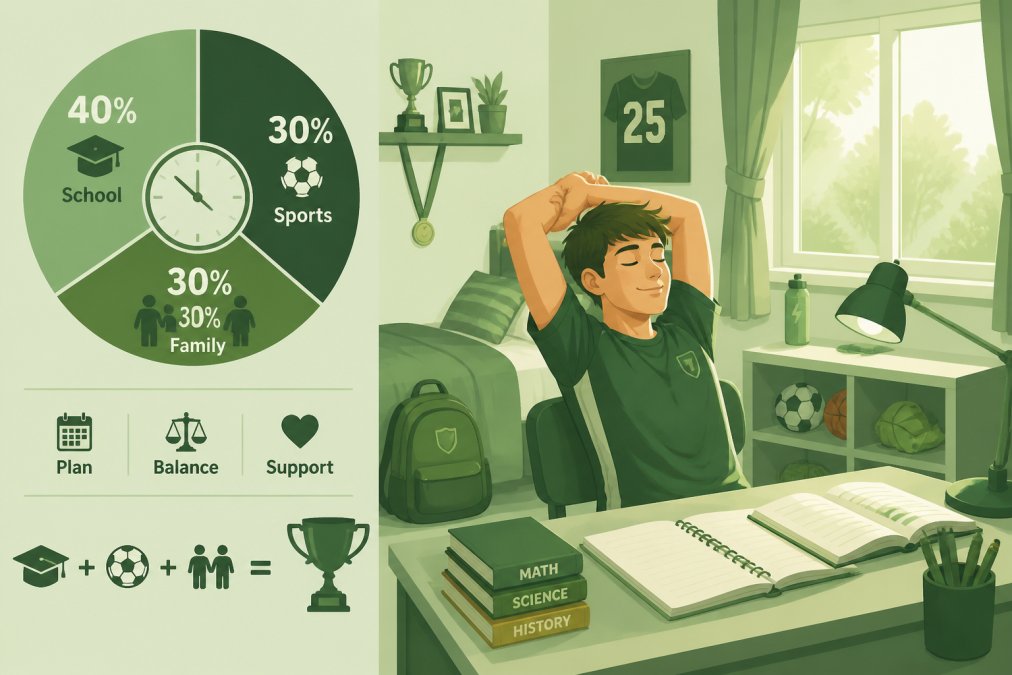
Recovery time at home, unstructured, unscheduled time, is when athletes process experiences, do homework, and recharge emotionally. Families that run from school to practice to homework to bed have no recovery time, making the schedule itself a source of anxiety.
Practical Stress-Management Techniques for Athletes
Young athletes need concrete, learnable techniques for managing the emotional and physical stress that accumulates during intense training and competition.
Diaphragmatic breathing activates the parasympathetic nervous system, which calms the body. Breathe in slowly through the nose for a count of four, hold for four, exhale for four. Practice daily and use it before competition or when anxiety rises.
Progressive muscle relaxation reduces physical tension by systematically tensing and releasing different muscle groups. This 10-minute practice can be done before bed to improve sleep quality.
Mindfulness practices help athletes observe anxious thoughts without being controlled by them. Simple practices include body scans or mindful observation.
Process-oriented goals reduce performance anxiety significantly. Instead of focusing on outcomes, athletes set process goals like "Execute the defensive strategy we practiced." Process goals are within the athlete's control, which reduces anxiety and improves performance.
Physical recovery practices are stress management. Sleep is non-negotiable, most young athletes need 8-10 hours nightly. Foam rolling, stretching, or light movement on rest days help the body recover and reduce physical tension.
Journaling gives athletes a place to process emotions and track patterns. Write for five minutes after practice about how you felt and what you learned.
Social support is a stress-management technique often overlooked. Athletes who have close teammates, supportive coaches, and family members who listen handle stress better.
Conclusion
Managing youth sports schedule stress is one of the most valuable skills you can develop as a parent of an athlete. It requires honest assessment, clear boundaries, and practical tools that keep your family organized and your athlete healthy.
When you're ready to show up for your athlete, whether at game day, practice, or family dinner, you want gear that represents your commitment and pride. Merch by Mary Ellen offers personalized sports apparel and accessories that let your family celebrate together with custom-style options, quality team spirit gear, and designs that work for the whole family. From game-day t-shirts to travel mugs for long tournament weekends, we help you create the coordinated look that shows your support. Explore personalized sports apparel options to find gear that matches your family's style and values.
Frequently Asked Questions
What are the signs of burnout in youth athletes?
Burnout appears as persistent fatigue, declining performance despite training, emotional withdrawal from sports, irritability, sleep problems, and loss of enjoyment in activities the athlete once loved. Physical signs include frequent illness, muscle tension, and headaches. Mental exhaustion manifests as difficulty concentrating, anxiety before games, and negative self-talk. If your athlete shows multiple signs simultaneously, it's time to reassess their training load and schedule intensity.
How can I help my child manage sports-related anxiety?
Start with diaphragmatic breathing exercises: have your athlete breathe in for a count of 4, hold for 4, and exhale for 4. Practice progressive muscle relaxation by tensing and releasing muscle groups. Teach process-oriented goals focused on effort and technique rather than winning. Maintain open communication about fears and expectations. Ensure adequate sleep, nutrition, and recovery time. Consider working with a sports psychologist if anxiety significantly impacts performance or well-being.
Why do so many kids quit youth sports?
Research indicates that approximately 70% of children quit organized sports by age 13, primarily due to excessive pressure, overtraining, schedule conflicts with academics and social life, and loss of enjoyment. Financial stress from equipment, fees, and travel also plays a role. When the focus shifts entirely to winning and performance outcomes rather than skill development and fun, young athletes lose motivation. Creating a balanced schedule, emphasizing process over results, and ensuring adequate recovery time helps retain athletes in sports.
How can I balance my child's sports commitments with school and family time?
Create a weekly routine that allocates specific time blocks for sports, academics, family activities, and rest. Use youth sports scheduling apps to visualize conflicts and gaps. Set firm boundaries on the number of practices and competitions per week, typically 3-4 practices plus 1-2 games is sustainable for most ages. Schedule regular family dinners and one full rest day weekly. Communicate with coaches about your family's priorities. Remember that academics and mental health must remain priorities alongside athletic development.
This article was written using GrandRanker