

Table of Contents
- What Makes Personalized Baseball Jerseys Different
- How to Design a Custom Baseball Jersey
- Custom Baseball Jerseys with Names and Numbers
- Youth Baseball Jersey Size Chart and Fit Guide
- Selecting Youth Baseball Team Uniforms
- Quality, Durability, and Care for Custom Team Apparel
- Ordering Timeline, Minimums, and Delivery
- Frequently Asked Questions
Last Updated: October 6, 2026
What Makes Personalized Baseball Jerseys Different
Personalized baseball jerseys for youth sports teams turn standard uniforms into keepsakes that unite players around a shared identity. Custom jerseys embed your team's name, player names, numbers, and colors into every garment, creating belonging that goes beyond the field.
At Merch by Mary Ellen, we know youth uniforms are both game-day gear and emotional symbols of team unity. We offer a dedicated Baseball Collection designed specifically for youth teams, alongside our Shop for Kids where you'll find sizing and styles built for young athletes.
The key distinction is customization depth: you control design elements, colors, and personalization placement. Quality custom jerseys also use breathable fabrics and durable stitching that withstand sliding, diving, and wash cycles.
How to Design a Custom Baseball Jersey
Designing a custom baseball jersey starts with a clear vision.

Next, select your jersey style. Crew necks are simpler and cleaner. Younger players often prefer crew necks.
Use an online customizer to preview your design before ordering. Test font sizes and positions so names and numbers stay readable and centered.
Document final specs in writing: colors (RGB or hex codes), exact team name spelling, player names and numbers, and any special characters or logos.
Custom Baseball Jerseys with Names and Numbers
Adding player names and numbers transforms a team uniform into individual achievement wear, a keepsake players treasure long after the season ends.
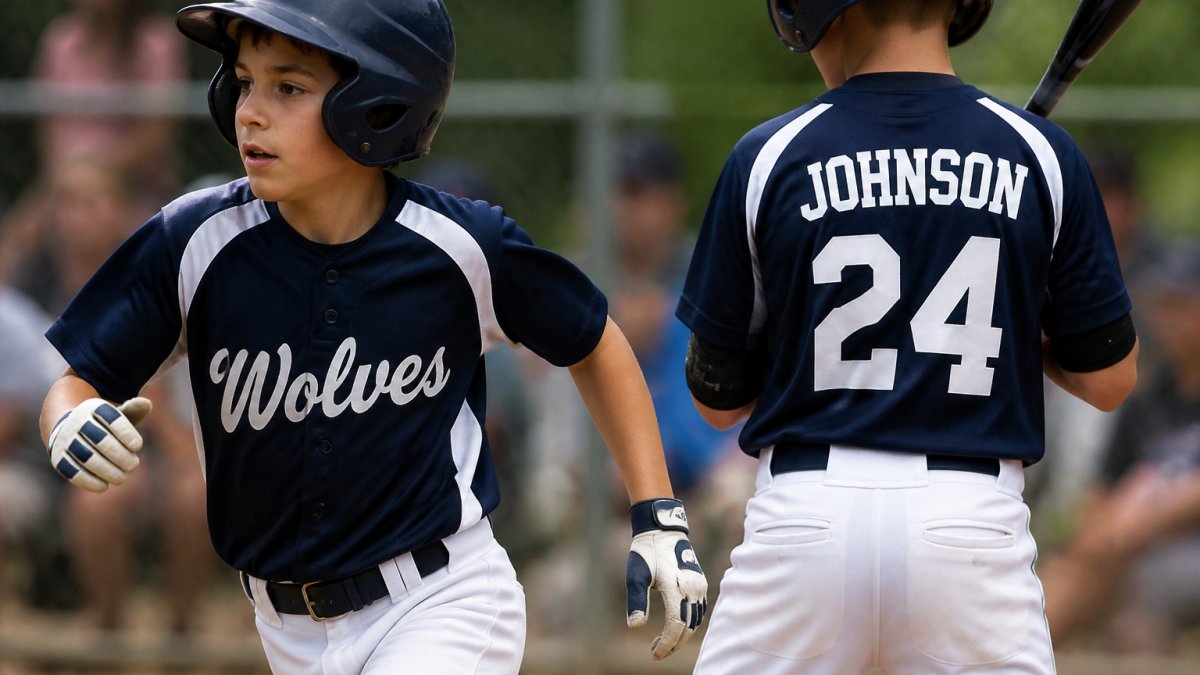
Position player names at shoulder height on the back, with numbers below. Standard sizing: numbers 4-6 inches tall (readable from the bleachers), names 1-2 inches tall.
Quality matters because names and numbers endure repeated washing. Screen prints can fade or crack without quality inks; heat-pressed vinyl can peel under aggressive laundering.
Most teams use this format: team name (front), last name (back upper), number (back lower), with the season year sometimes below the front team name.
Youth Baseball Jersey Size Chart and Fit Guide
Fit is the biggest source of returns, exchanges, and mid-season reorders in youth baseball. A jersey that's too tight restricts a swing; one too loose looks sloppy and catches on slides. Here's the measurement method, a size reference, and the brand-variance caveats most catalogs omit.
How to Measure a Youth Player
Use a soft tape and take three measurements:
- Chest, wrap the tape around the fullest part of the chest, under the arms, keeping the tape level and snug but not tight. Have the player breathe normally; don't ask them to puff up.
- Waist, measure at the natural waistline, roughly at the belly button, for players who will tuck the jersey or wear it over a belt.
- Torso length, measure from the top of the shoulder (near the neck) straight down to the hip bone. This is the measurement most size charts omit and the one that determines whether the hem sits right.
Record everything in inches. For a whole roster, collect measurements at one practice for consistency.
Working Size Reference
Use this as a starting point, then confirm against the vendor's specific chart, youth athletic sizing isn't standardized.
| Age Range | Typical Size | Chest (in) | Torso Length (in) |
|---|---|---|---|
| 6-8 years | XS | 24-26 | 18-19 |
| 8-10 years | S | 26-28 | 20-21 |
| 10-12 years | M | 28-32 | 22-24 |
| 12-14 years | L | 32-36 | 25-27 |
| 14+ years | XL | 36+ | 28+ |
Why Two 10-Year-Olds Can Need Different Sizes
Age is a weak proxy for size. A 10-year-old mid-growth-spurt may need a L while a same-age teammate fits an S, height, wingspan, and build matter more than birth year. Ordering blind? Ask parents for height, weight, and a current t-shirt size.
Brand-to-Brand Variance
Youth jersey sizing varies between manufacturers, two jerseys labeled "Youth M" can differ by an inch or more in chest width. Before a bulk order:
- Request the vendor's size chart for the specific jersey style you're ordering, not a generic youth chart.
- If the vendor offers a sample or single-unit purchase, order one in the middle size and have a player try it on.
- Ask whether the jersey is cut for wearing over a base layer or fitted against the body.
Fit Rules of Thumb
- Chest: should allow a full arm swing and overhead reach without the fabric pulling across the back.
- Hem: should reach the hip or slightly below, not bunch at the waist, not extend past the hip.
- Sleeves: should end near the wrist bone with arms relaxed at the sides.
- Between sizes: size up. Quality performance fabrics shrink minimally, and a slightly roomy jersey reads better than a tight one.
Planning for Growth
Youth players grow during the season. A jersey that fits perfectly in March may be snug by June. Two practical options:
- Order one size up for players in a growth spurt, especially if the jersey is a multi-season investment.
- Order a small buffer of extra jerseys in the most common sizes so a mid-season replacement doesn't require a full reorder.
Reducing Returns
Most returns trace to three causes: guessing by age, using a generic size chart, or not measuring at all. Collect chest and torso length per player, confirm against the vendor's specific chart, and size up when in doubt.
Selecting Youth Baseball Team Uniforms
Choosing a uniform goes beyond colors and styles, you're selecting a garment that represents team identity, performs in games, and withstands youth sports.
Start with fabric. Moisture-wicking blends keep players cool; breathable construction lets sweat evaporate rather than cling. Cotton-feel fabrics offer comfort, while poly-blends add durability and quick-dry properties.
Customized One Team. One Heart. One Goal. Baseball Kids T-shirt →
Neckline and sleeves matter for comfort and performance. Crew necks offer simplicity and maximum shoulder mobility; button-fronts provide traditional aesthetics but add customization complexity.
Shoulder-to-shoulder taping and reinforced seams signal durability.
Fabric weight matters: lighter fabrics (4-5 oz) feel cooler but wear faster, while heavier ones (6-7 oz) last longer but run warm. Most youth jerseys sit at 5-6 oz, balancing comfort and longevity.
Quality, Durability, and Care for Custom Team Apparel
Print quality determines how custom jerseys look after many wash cycles. Screen-printed designs should use high-quality inks that bond with the fabric.
A quality jersey keeps its shape and color after many wash cycles: seams intact, no pilling or fading, and no cracking or peeling of the customization.
Avoid bleach unless absolutely necessary, chlorine damages both fabric and print. Treat stubborn stains before washing rather than relying on bleach.
Tear-away labels prevent neck irritation during play, a small detail that matters for young athletes sensitive to scratchy tags. Seamless collars and taped shoulders add comfort at no extra cost.
Ordering Timeline, Minimums, and Delivery
"Allow 2-3 weeks" isn't enough to plan a season. Here's the full ordering picture: what drives cost, how minimums and reorders work, how proofing prevents mistakes, and how to build a timeline that survives a late roster addition.
What Actually Drives Your Total Cost
The per-jersey price is rarely the number you pay. A realistic budget accounts for:
- Base jersey cost, varies by fabric weight, cut, and whether the jersey is stock or fully custom.
- Name and number personalization, often priced per player, sometimes bundled.
- Team name and logo application, screen print, heat transfer, or embroidery, each priced differently.
- Artwork or setup fee, a one-time charge to prepare your logo or design for production. Some vendors waive it above a quantity threshold.
- Shipping, flat rate, weight-based, or free above a cart minimum.
- Rush fees, added when you need production faster than the standard window.
Get a written, itemized quote before committing, a per-jersey price alone is incomplete.
Minimum Order Quantities
Minimums vary widely:
- No minimum, some print-on-demand and direct-to-garment providers accept single units, but per-unit cost is higher and turnaround can be longer.
- Small minimums (6-12), typical for smaller youth programs and travel teams.
- Standard minimums (12-24), common for screen-printed team orders, where setup costs are spread across more units.
Reorders and Late Roster Changes
Rosters change, a player joins in week three, a jersey gets lost, a number changes. Before ordering, ask the vendor:
- Can I reorder a single jersey later? Some vendors keep your design on file and can produce one-offs; others require a new minimum.
- Will the reorder match the original exactly? Fabric dye lots and print runs can vary slightly between orders. Ask whether the vendor holds your screens or files to keep future units consistent.
- How fast can a replacement ship? Rush production on a single jersey is usually possible but priced higher.
- Can I add a player mid-season without reordering the whole team? This is the question most teams forget to ask until they need it.
Proofing and Artwork Requirements
Proofing is where costly mistakes are caught, or missed. Before production:
- Submit artwork in the right format. Vector files (AI, EPS, PDF) scale cleanly for logos; raster files (PNG, JPG) need to be high resolution or they'll look pixelated when printed.
- Review the digital proof carefully. Check spelling of every player name, every number, the team name, and any special characters. Read it out loud.
- Confirm placement. Front team name, back name and number, sleeve patches, verify each element is where you expect it.
- Ask about revision rounds. Most vendors include one or two proof revisions; additional rounds may cost extra or delay production.
- Get written approval before production starts. Once the proof is approved, changes are usually not possible without a new order.
Building a Realistic Timeline
Work backward from your first game:
| Stage | Typical Duration |
|---|---|
| Design and proofing | 2-5 business days |
| Production | 7-15 business days |
| Shipping | 3-7 business days |
| Buffer for issues | 3-5 business days |
That's roughly four to six weeks from order to delivery for a standard team order. Rush options compress production but add cost and reduce your margin for error, if your first game is three weeks out, you're already in rush territory.
Tracking and Delivery
Most vendors provide an order status page or tracking number once production ships. Check it weekly to flag problems early, and if the order ships to one address, plan who receives it and how it reaches players before the first game.
Frequently Asked Questions
Can I customize personalized baseball jerseys with my team's specific name and player numbers?
Yes. Most youth baseball jerseys allow full customization on both front and back. The front typically displays your team name, division, and season year, while the back shows individual player names and jersey numbers. This creates a cohesive team look where every player feels like part of an official roster. Confirm customization options before ordering to ensure the specific details you need are available.
What's the best way to choose the right size from a youth baseball jersey size chart?
Measure your player's chest width and length from shoulder to hem, then compare to the size chart provided by the vendor. Youth sizes typically range from XS to XL, with slight variations between brands. Order one size up if your child is between sizes or will grow into the jersey during the season. Always check the specific measurements rather than relying on age alone, since athletic youth vary significantly in build.
How do I know if a custom baseball jersey will hold up through a full season of play?
Look for jerseys made from durable blends like 50/50 cotton-poly or high-quality cotton with double-needle stitching at seams and hems. Check that the print or embroidery is done with quality processes designed to withstand multiple washes. Care instructions matter too, machine wash warm inside-out with similar colors, tumble dry low, and avoid ironing directly over printed designs. Proper care preserves print quality and prevents fading or peeling.
How long does it take to get personalized baseball jerseys delivered for a tournament?
Delivery timelines vary by vendor and order complexity. Standard orders typically ship within 7-14 business days, but rush options may be available for an additional fee. If your tournament is within 10 days, contact the vendor immediately to confirm they can meet your deadline. Placing your order early with final roster details prevents last-minute delays and ensures all players receive their jerseys in time for game day.