

Table of Contents
- Screen Printed vs Embroidered Shirts: The Core Differences
- Screen Printing vs Embroidery Cost: Pricing Breakdown
- Screen Printing vs Embroidery Durability: Longevity and Wear
- Design Complexity and Detail: What Each Method Handles Best
- Screen Printing vs Embroidery Professional Look: Aesthetic Appeal and Feel
- Custom Apparel Decoration Techniques: Beyond These Two Methods
- Common Mistakes to Avoid: Poor Outcomes and Artwork Preparation
- When to Choose Screen Printing vs Embroidery: Practical Scenarios
Screen Printed vs Embroidered Shirts: Which Works Best?
Last Updated: July 25, 2026
When ordering custom apparel for your team, family, or event, the choice between screen printed vs embroidered shirts affects durability, cost, appearance, and longevity. At Merch by Mary Ellen, we've helped thousands of customers navigate this choice. Screen printing excels at detailed designs and large orders, while embroidery delivers premium feel and exceptional longevity. Below, we'll show you exactly how to choose based on your specific needs.
Screen Printed vs Embroidered Shirts: The Core Differences
What Is Screen Printing?
Screen printing is a stencil-based method where ink is pushed through a fine mesh screen onto the garment. A separate screen is created for each color in your design. The ink sits on top of the material, creating a flat, vibrant finish.
The process requires setup for each color layer. If your design has five colors, you need five screens and five passes through the press. This is why screen printing offers significant cost advantages on bulk orders, once screens are made, each additional shirt costs only pennies more. The ink bonds with fabric fibers, allowing screen-printed designs to last for years with proper care.
What Is Embroidery?
Embroidery uses thread stitched directly into the fabric to create the design. A machine reads a digitized file and stitches thread through the garment in precise patterns, building up the design layer by layer. The thread sits above the fabric surface, creating three-dimensional texture that screen printing cannot replicate.
Embroidery doesn't require separate setups for different colors, the machine automatically changes thread colors as it stitches. This makes embroidery efficient for small orders or designs with many colors. The stitched design is mechanically locked into the fabric, which is why embroidered logos resist fading and cracking far better than screen-printed ones over extended wear.
Screen Printing vs Embroidery Cost: Pricing Breakdown
Cost is where these two methods diverge most dramatically.
Setup and Artwork Costs
Screen printing requires artwork preparation and screen creation. Your design must be color-separated into individual layers for each ink color. This setup cost is typically amortized across large orders, for a 100-shirt order, that setup cost might add $0.50 per shirt, but for 500 shirts, it drops to $0.10 per shirt.
Embroidery requires digitization, converting your design into stitch instructions. Digitization costs are typically lower than screen printing setup and don't scale with order size. Whether you're ordering 10 shirts or 500, the digitization cost remains fixed, usually between $25 and $75 depending on design complexity.
Per-Unit Pricing by Order Size
Per-unit costs decrease as order volume increases. For embroidery, per-unit costs remain relatively stable across order sizes because the machine setup is the same whether you're running 10 or 100 units. This makes embroidery more competitive for small orders but less attractive for bulk runs.
| Order Size | Screen Printing Advantage | Embroidery Advantage | Best Choice |
|---|---|---|---|
| 1-25 units | High setup cost per unit | Fixed digitization cost | Embroidery |
| 25-75 units | Setup cost declining | Still competitive | Depends on design |
| 75-200 units | Per-unit cost now lower | Costs add up | Screen printing |
| 200+ units | Significant savings | Less economical | Screen printing |
Screen Printing vs Embroidery Durability: Longevity and Wear
How Fading and Cracking Occur
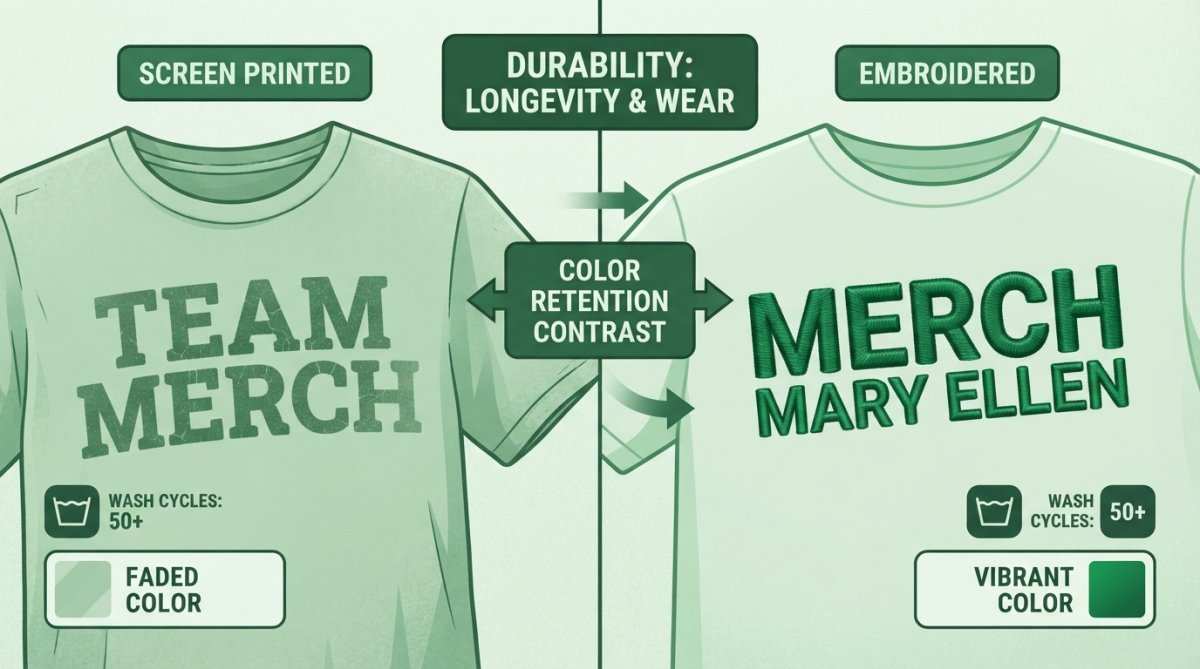
Screen-printed designs fade because the ink sits on the fabric surface. With repeated washing and sunlight exposure, the ink gradually breaks down. The ink can also crack if the garment is stretched repeatedly in that area.
Quality ink matters tremendously. Premium plastisol inks resist fading far better than budget inks. A well-executed screen print with quality ink can last 50+ wash cycles without significant fading.
Embroidered designs don't fade because thread doesn't break down like ink. However, thread can snag, pull, or break if caught on something. Stitches can also loosen over time if the garment is stretched aggressively or washed in hot water with rough agitation.
Wash Cycles and Care Requirements
Screen-printed garments should be washed in cold water, inside-out, and on a gentle cycle to maximize ink longevity. Most screen-printed designs remain vibrant for 50-100 wash cycles with proper care.
Embroidered garments benefit from similar care but tolerate more aggressive conditions. They can handle warm water and normal wash cycles without significant degradation. Embroidered designs often outlast screen-printed ones by 2-3x when both garments receive average care.
For uniforms and frequently-washed apparel, embroidery wins the durability test. For promotional items worn occasionally, screen printing's lower cost often makes the shorter lifespan acceptable.
Design Complexity and Detail: What Each Method Handles Best
Gradients, Fine Lines, and Photo-Quality Images
Screen printing handles gradients beautifully by layering semi-transparent inks. Fine lines and detailed artwork also print cleanly because ink can render small details that thread cannot.
Photo-quality images are possible with screen printing through halftone printing, where the image is converted into tiny dots of varying sizes. This technique allows screen printing to reproduce photographs with surprising detail.
Embroidery struggles with fine lines and gradients. Thread has a minimum width, you cannot stitch a line thinner than the thread itself. Photorealistic embroidery is essentially impossible.
However, embroidery excels at bold, solid designs with clear color separation. A logo with distinct color blocks, text, and geometric shapes looks exceptional in embroidery. The three-dimensional texture adds sophistication that flat screen printing cannot match.
Stitch Count and Digitization Challenges
Every embroidered design has a stitch count, the total number of stitches required to complete the design. Complex designs with fine detail can reach 20,000+ stitches, which becomes expensive and time-consuming.
Digitization errors are common when designs aren't properly prepared for embroidery. This is why working with experienced digitizers matters, they understand how to adapt designs for thread's limitations.
Screen printing avoids these issues entirely. Your design file is simply separated into colors; there's no special adaptation needed.
Screen Printing vs Embroidery Professional Look: Aesthetic Appeal and Feel
Texture and Premium Feel
Embroidered designs have raised texture that you can feel when you touch the garment. This three-dimensional quality signals premium quality and higher-end craftsmanship.
Screen-printed designs lie flat against the fabric and feel smooth. This is an advantage for comfort, as embroidered designs can feel slightly stiff in certain areas, especially if the stitch count is high.
For corporate apparel and uniforms, embroidery's tactile quality matters. For casual wear or athletic apparel, screen printing's comfort advantage is more relevant.
Best Garment Types for Each Method
Screen printing works best on cotton t-shirts, sweatshirts, and hoodies where the flat surface accepts ink cleanly. It also works on polyester and blends.
Embroidery works best on structured garments like polos, caps, jackets, and dress shirts where the fabric has enough body to support stitching. Embroidery on thin, stretchy fabrics can pucker or distort because stitching pulls the fabric out of shape.
At Merch by Mary Ellen, we recommend screen printing for casual apparel and embroidery for professional or athletic wear where durability and premium appearance matter most.
Custom Apparel Decoration Techniques: Beyond These Two Methods
Direct-to-Garment (DTG) Printing
Direct-to-garment printing uses inkjet technology to print designs directly onto fabric. DTG excels at photorealistic images, unlimited colors, and small orders with no setup cost.
However, DTG prints fade faster than screen printing and don't have the durability or premium feel of embroidery. DTG is best for designs that prioritize visual complexity over longevity.
Heat Transfer and Other Alternatives
Heat transfer involves printing a design onto special transfer paper and heat-pressing it onto the garment. It's fast and affordable for small runs but eventually peels and cracks with washing and wear. Heat transfers are suitable for temporary or short-term wear items.
Other methods like vinyl cutting, sublimation, and appliqué exist but are less common. Screen printing and embroidery remain the industry standards for quality and durability.
Common Mistakes to Avoid: Poor Outcomes and Artwork Preparation
Artwork File Types and Digitization Errors
Screen printing requires vector artwork in formats like EPS, AI, or PDF. Raster images (JPEGs, PNGs) don't work well because they lack clean edges. Submitting a low-resolution raster image forces the printer to manually trace it, adding cost and potential distortion.
Embroidery requires digitized files in formats like PES, EXP, or JEF. These are stitch instructions, not images. Submitting a regular image file for embroidery won't work, it must be properly digitized first.
Color Separation Missteps and Design Oversights
Screen printing requires color separation. A common mistake is submitting a design with too many colors, each color requires a separate screen, which increases setup costs dramatically. Designs with 4-6 colors are ideal; designs with 8+ colors become expensive.
Another mistake is not accounting for ink transparency. If you're printing a light color over a dark shirt, you may need a white underbase layer to make the color visible.
For embroidery, common oversights include designs with too many colors (which increases stitch count and cost), designs with very thin lines (which thread cannot render), and designs with small text (which becomes illegible when stitched).
When to Choose Screen Printing vs Embroidery: Practical Scenarios
Bulk Orders and Promotional Items
If you're ordering 100+ shirts for a company event, promotional giveaway, or team uniform, screen printing is almost always cheaper per unit. The setup cost is amortized across so many units that the per-unit price becomes unbeatable.
For bulk orders, screen printing also offers consistency. Every shirt is identical because the same screen is used for every print.
Small Orders and Uniforms
If you need just 10-25 custom shirts, embroidery's fixed digitization cost makes it competitive with screen printing's high per-unit setup fees. For small orders, embroidery wins on cost.
For uniforms that will be washed frequently and worn for extended periods, embroidery wins on durability. A uniform embroidered with a company logo will maintain its appearance far longer than a screen-printed one.
Choosing between screen printing and embroidery doesn't have to be complicated. If you're ordering in bulk and cost matters most, screen printing wins. If durability, premium appearance, and small quantities are your priorities, embroidery is the answer. The Merch by Mary Ellen team can help you navigate this decision with personalized guidance on which method suits your design, budget, and timeline. Explore our customizable apparel options and get started with a consultation today to ensure your custom garments deliver exactly what you're looking for.
Frequently Asked Questions
Which lasts longer: embroidery or screen printing?
Embroidery generally outlasts screen printing. Embroidered designs use thread stitched into the fabric, making them resistant to fading and cracking through wash cycles. Screen printing relies on ink applied to the surface, which can fade or crack after repeated washing and wear. For items you'll wash frequently, embroidery offers superior longevity.
Is screen printing or embroidery cheaper for custom shirts?
Screen printing typically costs less per unit for large bulk orders due to lower per-unit pricing at scale. However, embroidery may be more economical for small orders or single items. Setup costs, artwork preparation, and order quantity all affect final pricing. Contact a custom apparel provider for a quote based on your specific needs.
What types of designs are best for screen printing vs embroidery?
Screen printing excels with designs featuring gradients, fine detail, and photo-quality images. It handles complex color separation well. Embroidery works best for bold logos, text, and solid designs with higher stitch counts. Detailed gradients and fine lines are challenging for embroidery due to digitization limitations. Choose based on your design's complexity and color requirements.
Can you combine embroidery and screen printing on one shirt?
Yes, many custom apparel providers offer combo decoration. You might embroider a logo on the chest and screen print text on the sleeve. This hybrid approach lets you leverage the strengths of each method, embroidery's premium feel and durability with screen printing's design flexibility. Discuss combination options with your provider.
What fabrics work best for screen printing and embroidery?
Screen printing works on most fabrics: cotton, polyester blends, and synthetics. Embroidery requires stable, tightly woven fabrics like 100% cotton or cotton-blend polos and jackets to prevent puckering. Delicate or loosely woven fabrics may not support embroidery well. Screen printing is more forgiving across fabric types, while embroidery demands sturdier garment construction.
This article was written using GrandRanker