

Table of Contents
- Why Height and Weight Beat the Age on the Tag
- Kids Clothing Size Chart by Height and Weight: How to Read One
- How to Measure a Child for Clothing at Home
- The Difference Between T Sizes and Regular Sizes
- When to Size Up vs. Size Down (and Why Fabric Matters)
- What to Check Before You Order Custom or Team Gear
- Frequently Asked Questions
Last Updated: September 20, 2026
Why Height and Weight Beat the Age on the Tag
Age-based labels are the single biggest reason kids clothing sizes frustrate parents. A shirt marked "5T" can fit one five-year-old perfectly and hang off another like a bedsheet. At Merch by Mary Ellen, we see this every season with team gear and family matching sets. The fix is simple: shop by height and weight, not by the number printed on the tag.
Here's the uncomfortable truth most size charts won't tell you. Kids clothing sizes work best when you treat age as a starting guess and measurements as the real answer. Below, we'll show you how to read a size chart by height and weight, measure your child at home in five minutes, and know exactly when to size up or down.
The Problem With Age-Based Sizing
Age tells you almost nothing about fit. Two children born the same month can differ by several inches in height and several pounds in weight, and both are perfectly normal. A growth percentile simply describes where a child lands compared to peers of the same age, not whether they're "behind" or "ahead."
The CDC growth charts for children and teens make this clear: healthy kids spread across a wide band of heights and weights at every age. That's why a size chart keyed only to age will always misfit a chunk of the population.
How Growth Percentiles Change the Equation
A child tracking steadily along a high percentile for height will outgrow a size faster than a child on a lower percentile, even at the same age. Weight matters just as much, because it drives how a garment sits at the shoulders and waist.
Many parents find that checking their child's height-to-weight ratio against a brand's size chart beats guessing from age alone. If your child is tall and lean, you'll often need a larger size for length and accept a looser fit around the middle, or the reverse.
Kids Clothing Size Chart by Height and Weight: How to Read One
A kids clothing size chart by height and weight is a table that matches a child's measurements to a garment size, rather than relying on the age range on the label. Read it in this order: height first, weight second, then check the garment's own measurements.
Here's how the typical columns line up:
| What to Check | Why It Matters | What to Do |
|---|---|---|
| Height | Drives sleeve and leg length | Match to the closest size, round up |
| Weight | Affects shoulder and waist fit | Use as a tiebreaker between two sizes |
| Chest/waist | Predicts comfort and mobility | Compare to the garment's flat measurements |
| Inseam | Prevents too-short or dragging pants | Measure floor to crotch, not the old pant leg |
Retailer variations are real, so treat every brand's chart as its own document. A "6" at one shop is not a "6" at another.
How to Measure a Child for Clothing at Home
Measuring a child for clothing at home takes about five minutes with a soft measuring tape. You need four numbers: height, chest, waist, and inseam.
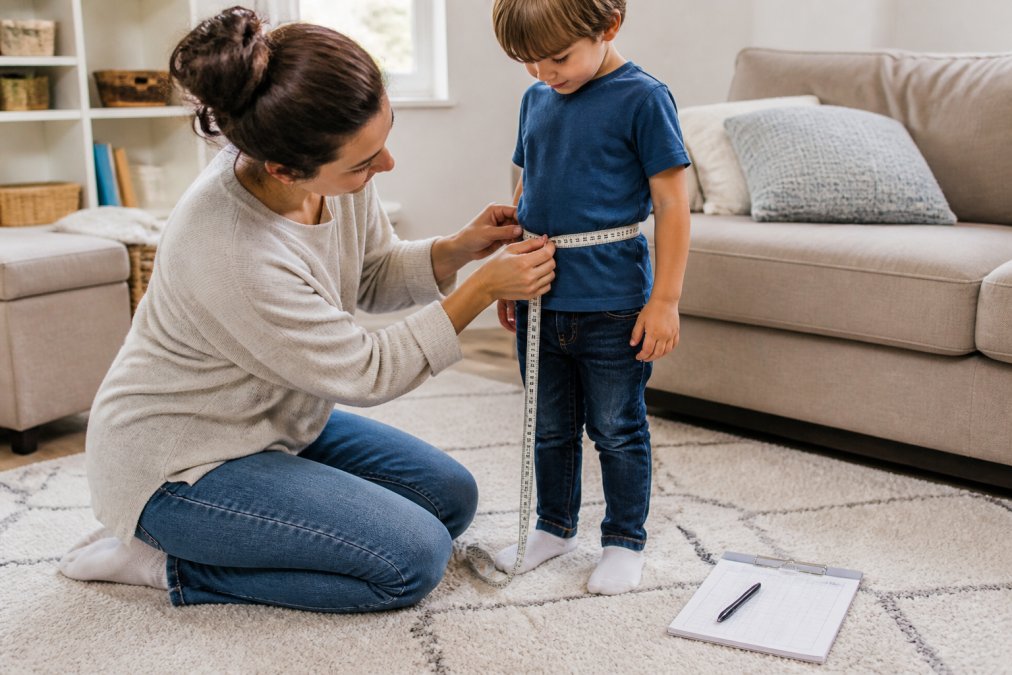
Follow these steps:
- Have the child stand straight against a wall, shoes off, heels together.
- Mark the top of the head and measure floor to mark for height.
- Wrap the tape around the fullest part of the chest, keeping it level.
- Measure the natural waist, then the hip at its widest point.
- For inseam, measure from the crotch seam to the floor.
- Write the numbers down and compare them to the size chart, not the age range.
Measurement accuracy matters more than speed. A tape pulled too tight or left too loose can shift a child a full size.
The Difference Between T Sizes and Regular Sizes
T sizes (2T, 3T, 4T, 5T) and regular sizes (4, 5, 6) are not the same cut with a different number. They are drafted for different bodies, and the gap between them is where most sizing confusion lives.
T sizes assume a toddler torso: shorter and rounder, with extra room through the seat and rise for diapers or training pants. The waistband sits higher, the crotch is lower, and the shoulders are cut narrower relative to the chest. Regular sizes assume a leaner, longer body, the rise drops, the torso lengthens, and the diaper room disappears. That is why a 4T and a 4 can both be labeled "4" and still fit completely differently on the same child.
The transition point is not the birthday, it is the diaper. A child still in diapers or pull-ups usually fits T sizing better because the rise and seat are built for the bulk. Once a child is fully out of diapers and gaining height quickly, regular sizes tend to fit more naturally because the torso and rise match a leaner frame. Many retailers stock both in the same aisle, which is why parents assume they are interchangeable. They are not.
There is a second layer most guides skip: the same numeric size can be cut differently across boy, girl, and unisex lines. A "6" in a boys' cut is often wider through the chest and shoulders with a straighter waist. A "6" in a girls' cut is often narrower through the shoulder with a slimmer waist and a longer rise. A unisex "6" usually splits the difference. None of these labels tells you the actual measurements, only the garment's flat measurements do. If you are buying for a child who sits between cuts, compare the chest and waist flat measurements, not the size number.
A quick fit checklist for the T-to-regular transition:
- Cuff of a long sleeve should hit at or just past the wrist bone, not cover the hand.
- Waistband should sit at the natural waist without leaving red marks or sliding down.
- Crotch seam should sit at the natural crotch, not hang low or pull up.
- Shoulder seam should land at the edge of the shoulder, not past it.
- Hem of pants should break once at the shoe, not pool on the floor.
When to Size Up vs. Size Down (and Why Fabric Matters)
Size up when height is at the top of a range, when the garment runs small, or when you want room for a seasonal growth spurt. Size down only when a brand runs notoriously large or the child is between sizes and prefers a snug fit.
Fabric composition and fit change the math here, and most guides skip it.
What to Check Before You Order Custom or Team Gear
Custom and team orders are the hardest to get right, because you can't return a shirt with a name and number on it. Collect every player's height and weight before you place the order, not their age.
A quick checklist for custom orders:
- Collect height and weight for every person on the roster
- Match each person to the closest size on the chart
- Confirm the garment's fabric and stretch before finalizing
- Order one sample size if the group is large
- Double-check names and numbers before submitting
Frequently Asked Questions
Is a 5T and XS the same size?
Often they are close, but not identical. A 5T is cut for a child around 42 to 45 inches tall and 40 to 45 pounds, with a little extra room through the seat for diapers or training pants. An XS in big-kid sizing usually starts around 44 to 46 inches and 45 to 48 pounds, with a slimmer cut. Because brands set their own ranges, check the specific kids clothing size chart for the item before you buy, especially for team or custom gear where returns are limited.
How do I find the right clothing size based on my child's height and weight?
Measure height against a wall without shoes, then measure weight on a scale. Match both numbers to the brand's kids clothing size chart by height and weight, not the age label. If height and weight point to two different sizes, go with the larger one for tops and hoodies, and the size that matches the waist for pants. A child at the 75th percentile for height but 25th for weight will need a slimmer fit than the age tag suggests.
Why do clothing brands use age-based sizing instead of measurements?
Age-based sizing is faster for shoppers and cheaper for manufacturers, who can cut one pattern and label it across a range. But children grow at very different rates. A 4-year-old can sit at the 10th percentile or the 90th for height, and both are normal. That is why a size 4 from one brand fits like a 5 from another. Treat age labels as a starting point and use height and weight to confirm.
How much does a child's growth spurt affect clothing fit?
A typical growth spurt adds about 2 to 3 inches of height over a season, which can move a child up a full size in a few months. Spring and summer spurts are common, so gear bought in early spring may be tight by fall. For team shirts and hoodies, order one size up if the season runs longer than three months, and check the size chart by height and weight rather than the age on the tag.
Getting kids clothing sizes right comes down to one habit: measure, then match. Age is a rough starting point, but height and weight are what actually decide whether a shirt fits on game day. Merch by Mary Ellen makes that easier with personalized sports and patriotic apparel, customizable options on select items, and a range of styles for the whole family. Get started with Merch by Mary Ellen and order gear that fits right the first time.