

Table of Contents
- Custom Team Shirts vs Store Bought: Key Differences
- Benefits of Custom Team Wear for Identity and Psychology
- Team Apparel Customization Options: Methods and Flexibility
- Best Printing Method for Team Shirts: Durability and Quality
- Cost of Custom Team Shirts: Budget Breakdown and Hidden Expenses
- Timeline, Logistics, and Environmental Considerations
- Which Option Wins: Custom Team Shirts vs Store Bought
- Conclusion: Making the Right Choice for Your Team
Last Updated: July 22, 2026
Custom Team Shirts vs Store Bought: Key Differences
When deciding between custom team shirts vs store bought apparel, the choice comes down to identity, durability, and long-term value. Custom apparel builds team identity and brand visibility but demands upfront investment, longer timelines, and minimum order quantities. Store-bought gear offers immediate availability and lower per-unit costs for small orders but lacks the personalization that creates genuine team cohesion.
What Defines Custom vs Standard Apparel
Custom apparel is clothing manufactured specifically for your team with personalized elements, logos, names, or unique color combinations. Store-bought apparel is mass-produced, off-the-shelf clothing available at retail locations or online retailers, designed for general consumers rather than specific groups.
The distinction affects everything downstream: cost per unit, design flexibility, turnaround time, and perceived value. Custom team wear typically requires a minimum order quantity (MOQ) of 12 to 25 units and takes 2 to 4 weeks to produce. Store-bought apparel is available immediately with no MOQ requirement.
Quick Comparison Table
| Factor | Custom Team Shirts | Store-Bought Apparel |
|---|---|---|
| Design Flexibility | Full personalization (logos, names, colors) | Limited to existing designs |
| Minimum Order | 12-50 units typical | 1 unit available |
| Turnaround Time | 2-4 weeks standard | Immediate or 1-3 days |
| Cost Per Unit | $12-$30+ (decreases with volume) | $15-$40 per shirt |
| Brand Visibility | High (custom logo/branding) | Low (generic or retail brand) |
| Durability | Depends on method and fabric quality | Variable by retailer |
| Best For | Teams needing unity and identity | Individual purchases or quick needs |
Benefits of Custom Team Wear for Identity and Psychology
Team Identity and Brand Visibility
Custom team apparel creates immediate visual cohesion and signals belonging. When your team wears matching custom shirts, strangers instantly recognize you as a unified group. This visibility extends beyond the field or office, it becomes a walking advertisement for your brand, event, or cause.
Research shows that people wearing matching apparel report higher sense of group identity and commitment to shared goals. For sports teams, this translates to perceived competitive advantage. For corporate teams, it reinforces workplace culture. Store-bought apparel cannot replicate this effect; even if everyone purchases the same generic t-shirt, the lack of customization signals that the group assembled quickly or without intentional branding.
Impact on Team Psychology and Unity
Wearing custom team apparel affects how members perceive themselves and their role within the group. Teams that wear unified custom gear report higher morale, stronger internal communication, and greater willingness to support teammates.
The effect is strongest when the custom design reflects the team's values or identity. A baseball team wearing custom jerseys with player names and numbers creates individual recognition within group unity. A corporate team wearing branded hoodies signals belonging to something larger than individual roles. Store-bought apparel misses this opportunity, generic retail shirts don't communicate identity or belonging.
Team Apparel Customization Options: Methods and Flexibility
Decoration Techniques Available
Three primary methods exist for customizing team apparel, each with distinct trade-offs in cost, durability, and visual impact.
Screen printing is the most cost-effective method for bulk orders. It involves pushing ink through a mesh screen onto the garment. For 25+ shirts, screen printing delivers the lowest per-unit cost and excellent durability. The limitation: screen printing works best with 1 to 4 colors. Complex multi-color designs require multiple screens, increasing setup costs.
Embroidery adds a premium feel through needle-and-thread stitching. It's more durable than screen printing and conveys higher quality. Embroidery works well for small logos, names, and numbers but costs significantly more per unit, making it less practical for large orders. It's ideal for smaller quantities (12-50 units) where premium appearance justifies the cost.
DTF transfers (direct-to-film) print full-color designs directly onto garments without setup fees, making them ideal for complex designs and small orders. However, DTF transfers are more expensive per unit than screen printing for bulk orders and may fade faster with repeated washing.
Design Flexibility and Personalization
Custom apparel offers near-unlimited design flexibility. You control colors, placement, sizing, font, and imagery. Store-bought apparel offers zero design flexibility, you select from what exists.
For team apparel, the practical limit on flexibility is your budget and timeline. Basic designs (single-color logo, team name) cost less and ship faster. Complex designs cost more and require longer production time. Most custom apparel providers offer design tools or work with you to refine artwork before production begins.
Best Printing Method for Team Shirts: Durability and Quality
Screen Printing vs Embroidery vs DTF Transfers
Durability differs significantly across methods, affecting long-term value and team satisfaction.
Screen-printed designs typically last 50+ washes before noticeable fading. The ink sits on top of the garment and gradually wears away. Screen printing delivers excellent durability for the cost, especially on cotton and cotton-blend fabrics.
Embroidered designs outlast screen printing by a wide margin, lasting 100+ washes without significant degradation. The stitching is physically integrated into the fabric, making it nearly impossible to fade or peel. This durability justifies the premium price for team apparel worn repeatedly.
DTF transfers fall between screen printing and embroidery in durability, claiming 50-70 washes before noticeable fading. DTF durability depends heavily on the quality of the transfer and proper garment care.
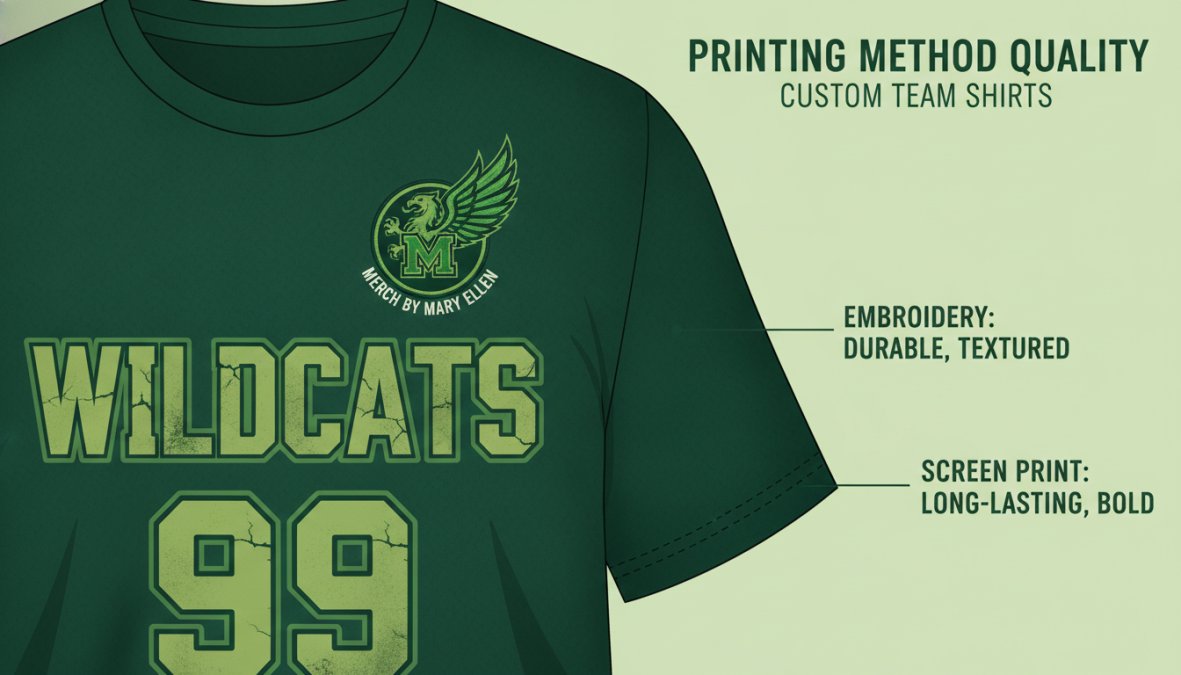
For team apparel meant to be worn repeatedly, embroidery or high-quality screen printing justifies the investment. For one-time events, DTF or basic screen printing suffices.
Fabric Quality and Garment Durability
Print durability depends entirely on the base garment. A premium screen-printed design on cheap cotton will deteriorate faster than the same design on quality fabric.
Fabric quality determines how well the garment holds up to washing and wear. Cotton-heavy blends (80% cotton, 20% polyester) balance comfort and durability. Pure cotton is softer but shrinks more. Polyester blends resist shrinking and maintain color. Performance fabrics (moisture-wicking polyester blends) are ideal for athletic teams.
Store-bought apparel often uses lower-quality fabrics to hit retail price points. Custom apparel providers typically offer fabric choices, allowing you to specify quality level. Higher-quality fabrics cost more but justify the investment if the shirts will be worn frequently.
Cost of Custom Team Shirts: Budget Breakdown and Hidden Expenses
Bulk Ordering vs Retail Pricing
For a single shirt, store-bought apparel is cheaper. Retail t-shirts run $15-$40 depending on brand and quality. Custom apparel has high setup costs that spread across units.
For bulk orders, custom apparel becomes cost-competitive. A 50-unit custom order might cost $12-$20 per shirt (total: $600-$1,000), while buying 50 retail shirts at $25 each totals $1,250. The break-even point typically falls between 20-40 units, depending on the provider and design complexity.
However, custom apparel requires upfront payment before production. You must commit to a design and quantity before receiving anything. Store-bought apparel allows incremental purchasing, spreading cost and risk.
Hidden Costs of Customization
Beyond the per-unit price, customization carries several hidden expenses.
Design fees ($25-$75), artwork preparation ($15-$50), and shipping ($30-$100+) add to the total cost. Most providers require minimum order quantities (12-25 units), so if you need 15 shirts and the MOQ is 25, you're buying 10 extras. Rush fees for expedited production (1-2 weeks) cost 25-50% more than standard timelines. Custom apparel is typically non-returnable, so defects become your loss.
Store-bought apparel avoids all these hidden costs. You pay the retail price, receive the item immediately, and can return it if sizing or quality is wrong.
Timeline, Logistics, and Environmental Considerations
Turnaround Time and Delivery Expectations
Custom apparel requires patience. Standard production timelines run 2-4 weeks from order to shipment, plus 3-7 days for shipping, totaling 3-5 weeks from order to delivery. Expedited production is available but expensive (25-50% surcharge). If your event is in 10 days, custom apparel is not viable unless you pay for rush production.
Store-bought apparel ships immediately or within 1-3 days. If you need shirts for an event next week, retail is the only practical option.
Small Batch vs Large Scale Logistics
For small batches (12-50 units), logistics are straightforward. The entire order arrives at one address within a predictable timeframe. For large scale orders (100+ units), some providers offer multi-address shipping, allowing you to split the order across multiple team locations, though this may incur additional fees.
Store-bought apparel avoids logistics complexity entirely.
Environmental Impact Analysis
Custom apparel is manufactured on-demand, reducing overproduction waste. If you order 50 shirts, 50 shirts are made with no excess inventory. However, custom production often requires longer shipping distances and uses dyes and inks specific to your design.
Store-bought apparel is mass-produced and shipped to retail locations. Unsold inventory is often discounted, donated, or discarded, creating waste. However, the per-unit environmental impact may be lower due to manufacturing scale.
For teams committed to sustainability, custom apparel with eco-friendly fabric options (organic cotton, recycled polyester) and responsible printing methods (water-based inks) minimizes impact.
Which Option Wins: Custom Team Shirts vs Store Bought
When Custom Team Shirts Make Sense
Custom team apparel is the right choice when team identity, brand visibility, or repeated wear justify the investment.
Sports teams benefit from custom jerseys and warm-ups. The personalization creates professional appearance, individual recognition, and team cohesion. Corporate teams use custom apparel for team building and internal culture. Nonprofits and volunteer organizations use custom apparel for fundraising and visibility. Events and conferences benefit when attendee volume justifies the MOQ. Recurring programs (seasonal sports, ongoing volunteer initiatives) maximize ROI because the apparel becomes a recognizable asset year after year.
The common thread: custom apparel makes sense when the team will wear the shirts repeatedly, visibility matters, or the group size justifies bulk ordering.
When Store-Bought Apparel Is the Better Choice
Store-bought apparel is the right choice when speed, flexibility, or small quantities are priorities.
One-time events with tight timelines (less than 2 weeks) require store-bought apparel. Small groups (fewer than 15 people) should buy retail apparel, the per-unit cost of custom production makes retail more economical. Uncertain participation makes store-bought sensible. Specialty sizes or fits are easier to find in retail. Budget constraints may force the store-bought decision. Casual, informal groups that don't need branded identity don't justify custom apparel investment.
The key question: is the team permanent or temporary? Will the apparel be worn repeatedly or once? Does the team need branded identity or just functional clothing?
Conclusion: Making the Right Choice for Your Team
The choice between custom team shirts vs store bought depends on your team's size, timeline, identity needs, and budget. Custom apparel builds brand visibility and team cohesion but requires planning, upfront investment, and minimum order quantities. Store-bought apparel offers speed, flexibility, and lower risk for small orders but lacks the personalization that creates genuine team identity.
For teams committed to building lasting identity and willing to invest in quality apparel, Merch by Mary Ellen offers personalization options on select items, access to specialized sports-themed designs, and the ability to customize clothing for your team's unique needs.
Frequently Asked Questions
What's the main difference between custom team shirts and store-bought apparel?
Custom team shirts are manufactured to your specific design, allowing complete control over logo placement, colors, names, and numbers. Store-bought apparel comes pre-designed and ready to wear. Custom options offer brand visibility and team identity but require longer lead times and higher minimum order quantities. Store-bought provides immediate availability and lower per-item costs for small quantities, though you sacrifice personalization and unique team branding.
How do printing methods affect the durability of custom team shirts?
Different printing methods deliver varying durability levels. Screen printing creates long-lasting designs resistant to fading and peeling after multiple washes. Embroidery offers premium durability with textured, three-dimensional results. DTF transfers provide full-color flexibility but may show wear sooner than screen printing. The best printing method for team shirts depends on your design complexity, budget, and how frequently the apparel will be washed. Higher-quality fabrics paired with proper printing techniques ensure your custom team wear maintains its appearance through a full season.
Is custom team apparel more expensive than buying from retail stores?
Pricing depends on quantity, dates, and delivery. For bulk orders (50+ shirts), custom team shirts often become cost-effective through volume discounts, potentially matching or beating retail prices while offering unique branding. Small orders (under 12 shirts) typically cost more per item through custom channels than buying pre-made retail apparel. However, custom options eliminate wasted inventory since you order exactly what you need. Consider the total value: custom team wear builds team psychology and brand recognition that retail apparel cannot match, even if per-unit costs are slightly higher.
How quickly can custom team shirts be produced and delivered?
Turnaround time varies by provider and order complexity. Standard custom orders typically take 5-14 business days for production plus shipping. Rush options may compress this to 2-5 days but include surcharges. Store-bought apparel offers immediate availability if shopping in-person or standard shipping if ordering online. If your tournament or event is within 10 days, confirm turnaround expectations directly with your provider, some specialize in rush production. Small batch vs large scale logistics also affect timing: larger orders sometimes take longer due to production schedules, while smaller quantities may move faster.
What are the hidden costs I should know about when ordering custom team shirts?
Beyond per-shirt pricing, watch for setup fees, design charges, art digitizing costs for embroidery, rush delivery surcharges, and multi-address shipping fees. MOQ (minimum order quantity) requirements may force you to order more than needed. Return policies vary, some providers don't accept returns on custom items if sizing doesn't fit. Environmental considerations like sustainable fabric upgrades or eco-friendly printing methods add cost but appeal to modern teams. Always request a complete quote including all fees before committing. Compare total landed cost, not just per-unit price, to make an informed decision between custom team shirts and store-bought options.
Start with these questions: How many team members will wear the apparel? How long will the team exist? Does branded identity matter? Will the apparel be worn repeatedly? Your answers determine whether custom or store-bought is the smarter investment. For teams needing personalized options and professional quality, explore Merch by Mary Ellen's customizable apparel options and get a quote today.
This article was written using GrandRanker