

Table of Contents
- Why Accurate Measurements Matter for Kids' Hoodies
- What You'll Need to Measure Kids for Hoodies
- Step-by-Step: How to Measure Chest for Kids Clothes
- Measuring Sleeve Length for Kids: A Visual Guide
- Complete Kids Hoodie Size Chart and Age Guidelines
- Tips for Buying Kids Clothes Online: Fit Considerations
- Common Mistakes to Avoid When Measuring Kids
- Conclusion: Getting the Right Fit Every Time
Last Updated: July 13, 2026
Getting the right fit for kids' hoodies can be tricky, especially when shopping online or ordering in bulk. This guide walks you through exactly how to measure kids for hoodies so you can confidently order sizes that actually fit. Whether you're buying for one child or a whole team, accurate measurements are the foundation of a perfect fit.
Why Accurate Measurements Matter for Kids' Hoodies
Ill-fitting hoodies are uncomfortable and get outgrown quickly, wasting money and frustration. A hoodie that's too tight restricts movement, while one that's too loose looks sloppy and can become a safety hazard if sleeves are dangerously long. Getting measurements right the first time saves you returns, exchanges, and reordering hassles.
Kids grow unpredictably, and sizing standards vary widely across brands. One manufacturer's size 10 might fit completely differently than another's. Precise measurement gives you concrete data to match against a kids hoodie size chart, rather than guessing based on age or vague size labels.
What You'll Need to Measure Kids for Hoodies
Before you start measuring, gather the right tools and set up a space where your child can stand comfortably.
Essential Tools and Setup
A soft fabric measuring tape is essential. Fabric tapes stretch slightly and conform to the body better than rigid metal ones. Avoid string or rope, which are difficult to read accurately.
Have your child wear a simple fitted t-shirt or nothing at all during measuring. Thick sweaters or bulky layers distort measurements and make it impossible to get accurate numbers. You want to measure the actual body, not the clothing.
Stand your child against a wall or in front of a mirror so you can see their posture. Good posture matters for accuracy. Ask them to stand naturally, feet flat on the ground, arms relaxed at their sides. Have a notepad or phone ready to write down each measurement immediately.
Step-by-Step: How to Measure Chest for Kids Clothes
Chest circumference is the most critical measurement for hoodie fit. This determines whether the garment will be comfortable across the shoulders, chest, and torso.
Understanding Pit to Pit Measurements
Pit to pit measurement means measuring from armpit to armpit across the front of the chest. This is the standard way the industry measures chest width on a flat garment.
Wrap the measuring tape around the fullest part of the chest, keeping it snug but not tight. The tape should sit horizontally, parallel to the ground, and pass directly under the armpits. The tape should feel firm against the skin but not compress the chest or restrict breathing.
Read the measurement where the tape overlaps at the front of the chest. A child's chest circumference typically ranges from 20 inches for a small 4-year-old to 32 inches for a larger 12-year-old, though this varies significantly.
Measuring Sleeve Length for Kids: A Visual Guide
Sleeve length determines whether your child can comfortably move their arms or if they're constantly pushing fabric up. This measurement is equally important as chest width for overall fit and function.
Finding the High Point Shoulder and Sleeve Head Point
The high point shoulder, or HPS, is the bony point at the top of the shoulder where the shoulder bone meets the neck. This is your starting point for sleeve length measurement. Feel along the top of their shoulder until you find the highest bony point where the shoulder slopes down.
To measure, place the measuring tape at the high point shoulder and run it down the outside of the arm, following the natural line from shoulder to wrist. Keep your child's arm relaxed and slightly bent at the elbow. The tape should follow the arm naturally, not pulled tight or hanging loose. The measurement ends at the wrist bone on the outside of the hand.
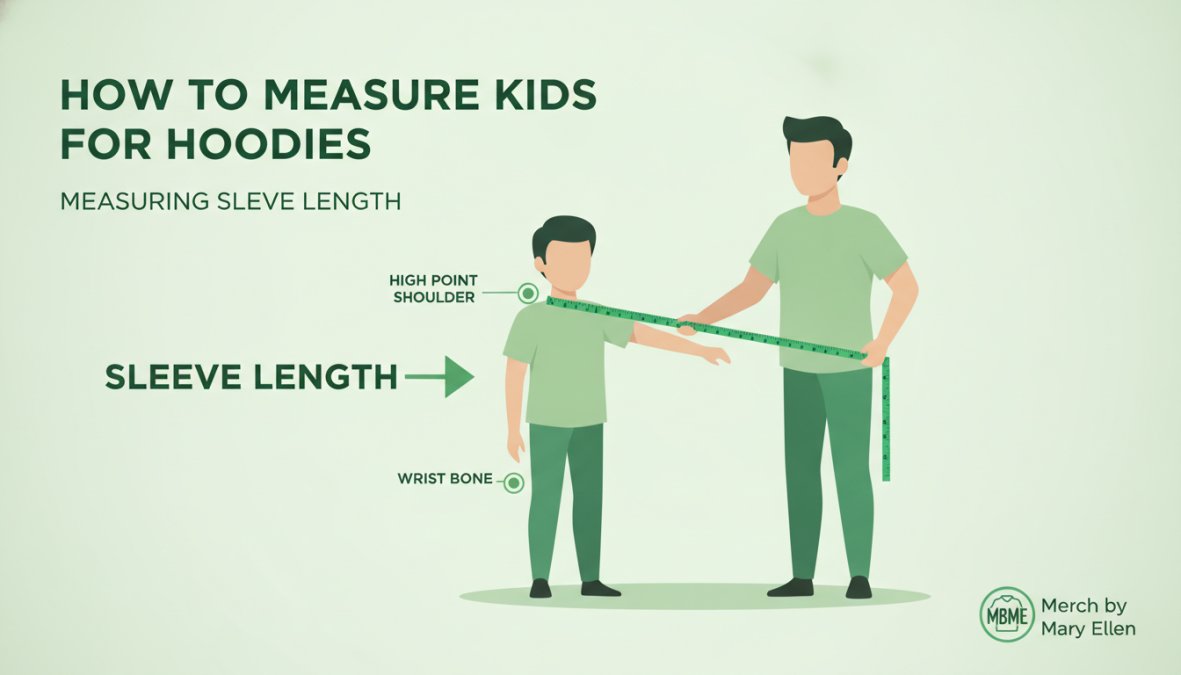
Sleeve length for kids typically ranges from 12 inches for a 4-year-old to 22 inches for a 12-year-old, but individual variation is significant.
Complete Kids Hoodie Size Chart and Age Guidelines
Age-based sizing is a starting point, but body measurements are your real guide. A size chart translates your measurements into an actual hoodie size.
Youth Unisex Sizing vs. Standard Kids Sizes
Most kids hoodies come in youth unisex sizing, which treats all kids the same regardless of gender. Youth unisex hoodies are cut to fit the average child body at each age range, without the curves or tailoring of adult women's sizes.
Standard kids sizes run from XS (extra small) through XL (extra large), with numeric sizes like 4, 6, 8, 10, 12, and 14 also common. These age ranges are approximations only and should not be your primary sizing method.
| Size | Age Range | Chest (inches) | Body Length (inches) | Sleeve Length (inches) |
|---|---|---|---|---|
| XS / 4 | 3-4 years | 20-22 | 16-18 | 12-13 |
| S / 6 | 5-6 years | 22-24 | 18-20 | 14-15 |
| M / 8 | 7-8 years | 24-26 | 20-22 | 16-17 |
| L / 10 | 9-10 years | 26-28 | 22-24 | 18-19 |
| XL / 12 | 11-12 years | 28-30 | 24-26 | 20-21 |
| XXL / 14 | 13+ years | 30-32 | 26-28 | 22-23 |
This chart shows typical youth unisex sizing, but individual brands vary. Always check the specific brand's size chart before ordering.
Height and Weight Correlation for Accurate Fit
Height and weight matter, but they're secondary to actual body measurements. A child who is tall and thin needs a different size than one who is short and stocky, even if they're the same age.
Look at your child's height and weight, then cross-reference with the chest, body length, and sleeve length measurements you took. If your measurements fall between two sizes, consider which dimension is most important. If sleeve length is the limiting factor, size up. If everything fits except body length is slightly long, that's often acceptable because kids can grow into it.
Tips for Buying Kids Clothes Online: Fit Considerations
Online shopping for kids' hoodies requires extra attention because you can't try them on first. Your measurements become your only reference point.
Measuring for Different Hoodie Fits
Not all hoodies are cut the same way. A relaxed-fit hoodie sits looser through the chest and shoulders, while a fitted hoodie hugs the body more closely. A zip hoodie might fit differently than a pullover because of how the front closure affects the overall silhouette.
Before ordering, check the product description for fit notes. Does it say "relaxed fit" or "true to size"? Some brands run large or small, and this information matters. For a relaxed fit, you can size down slightly if your child prefers a snug look. For a fitted hoodie, stick to your measured size or size up if your child likes room to move.
Growth Spurts and Sizing Up Strategies
Kids grow unpredictably, and growth spurts can add inches in a few months. A safe strategy is to size up only in body length, not in chest or sleeve length. If your child measures at a size 8 in chest and sleeve but is in a growth phase, buy a size 10 for the extra body length. This gives room for torso growth without making the chest or sleeves too large.
Alternatively, buy the correct size for now and plan to replace it in 6-12 months when growth catches up. This ensures the best fit during the time your child actually wears the hoodie.
Fabric Shrinkage and Care Considerations
Cotton and cotton-blend hoodies can shrink in the wash, especially if dried on high heat. A hoodie that fits perfectly fresh from the package might shrink a half-inch or more in the wash, particularly in chest circumference and body length.
Check the care instructions before ordering. If the hoodie is 100% cotton, expect potential shrinkage and consider sizing up slightly. If it's a cotton-polyester blend, shrinkage is minimal. When your child first gets the hoodie, wash it in cold water and air dry to minimize shrinkage.
Common Mistakes to Avoid When Measuring Kids
Understanding what not to do is as important as knowing the right technique.
Measuring over clothing is the most common error. Bulky sweaters and thick layers distort measurements. You must measure the body itself, not the clothing.
Pulling the measuring tape too tight creates measurements that are smaller than reality. The tape should be snug enough to sit flat against the skin, but not so tight it compresses the body or leaves marks.
Inconsistent posture between measurements wastes your effort. Have your child maintain the same relaxed, upright posture for all measurements.
Measuring at the wrong anatomical points leads to numbers that don't match any size chart. The chest measurement must be at the fullest part, sleeve length must start at the high point shoulder, and body length must be from the base of the neck to the desired hemline.
Forgetting to write measurements down immediately is surprisingly common. Write everything down as you go, and include the date and child's name so you can reference it later.
Ignoring brand-specific size charts is a mistake many parents make. A size 10 from one brand might fit completely differently than a size 10 from another. Always check the specific brand's chart, not a generic kids' sizing chart.
Conclusion: Getting the Right Fit Every Time
Measuring your child accurately takes a few extra minutes, but it's the difference between a hoodie that fits beautifully and one that sits in the closet unworn. The process becomes faster with practice, and you'll develop a sense for your child's measurements over time.
Getting the perfect hoodie fit for your child doesn't require guessing or hoping for the best. Merch by Mary Ellen offers many youth unisex hoodies in all standard sizes, with detailed size guides and personalization options available on select items. Start with your child's measurements, match them to the size chart, and you'll find the perfect fit every time. Subscribe to Merch by Mary Ellen for updates on new styles and seasonal collections that your whole family will love.
Frequently Asked Questions
What measurements do I need to take when measuring kids for hoodies?
You need three core measurements: chest circumference (pit to pit), sleeve length (from high point shoulder to wrist), and body length (from shoulder to bottom hem). For accurate garment measurements, measure with the child in an upright posture wearing a fitted shirt. Use a soft measurement tape and record all measurements in both inches and centimeters for flexibility when referencing size charts.
How do I measure chest for kids clothes accurately?
To measure chest circumference, wrap the measurement tape around the fullest part of the child's chest, keeping it snug but not tight. For a flat lay measurement of an existing hoodie, measure pit to pit (armpit to armpit) and double the number. Ensure the tape is parallel to the ground and the child stands in upright posture. This pit to pit measurement is crucial for determining proper fit and comparing against size conversion charts.
Should I size up when buying kids' hoodies to account for growth?
Sizing up depends on growth rate and fit preference. If your child is experiencing rapid growth spurts, consider sizing up by 1-2 inches in body length. However, avoid sizing up excessively in chest circumference, as oversized hoodies can look unflattering and affect mobility. A relaxed shoulders fit allows more room than a fitted style. Check the brand's size tolerance guidelines, and remember that fabric shrinkage may occur after washing, so factor that into your decision.
How do kids' hoodie sizes differ from youth unisex sizing?
Youth unisex hoodies typically offer a more relaxed fit through the shoulders and body compared to standard kids' sizing, which is often more tapered. Youth sizes are designed for older children and pre-teens with longer proportions, while kids' sizes work better for younger children. When choosing between youth unisex and standard kids' sizes, compare the garment measurements (chest circumference, sleeve length, and body length) against your child's measurements rather than relying on age range alone.
This article was written using GrandRanker